
The 'father' of Sao Vang balm and his vibrant life intertwined with Nghe An province.
(Baonghean.vn) - Every Vietnamese person has used Sao Vang balm at least once in their life. But few people know that the creator of this "miraculous" balm was physician Pho Duc Thanh, a prominent figure in Vinh city in the first half of the 20th century.
Phó Đức Thành, originally from Đa Ngưu village, Tân Tiến commune, Văn Giang district, Hưng Yên province, was born in 1880 in Ninh Bình.
In 1926, while comfortably settled in Hue as a road construction official and owner of a small business, Pho Duc Thanh repeatedly received offers of assistance from his cousin, Pho Duc Chu. Mr. Chu had opened a traditional medicine shop in Hanoi, but was being pressured by the Chinese and was unable to do business. Driven by a desire to prove that Vietnamese people could compete on equal footing with the Chinese in the field of traditional medicine, Pho Duc Thanh agreed to help and became the manager of Pho Duc Chu's shop.
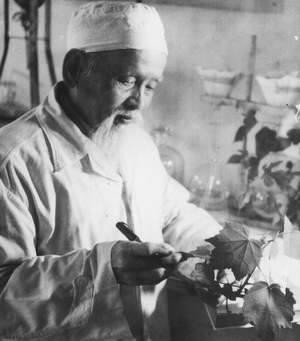 |
| Traditional medicine practitioner Pho Duc Thanh. |
However, instead of directly confronting the Chinese in their own territory, Fujian Street (Hanoi), he chose Vinh - Ben Thuy as his "base of operations." He argued that Vinh - Ben Thuy was a young city with many advantages in terms of transportation. The traditional medicine activities of the Chinese there were not as strong as in other places in Southern and Northern Vietnam. Furthermore, Nghe Tinh was a land of Confucianism, so there would be many Confucian scholars and many people who knew and used traditional medicine.
The business of selling traditional Vietnamese medicine would surely be profitable. Thinking this way, Pho Duc Thanh boldly abandoned everything he had in Hue to start a business in Vinh. From a small pharmacy, Pho Duc Thanh gradually established a strong position in the Vinh market. Once he was quite secure, he decided to invest heavily. In 1928, the event of Vinh Hung Tuong spending 20,000 dong to buy the building of the Civil Court located right in front of Vinh market to use as his headquarters can be considered a major turning point, truly transforming Vinh Hung Tuong into the number one force in traditional medicine not only in Vinh - Ben Thuy.
To compete with the Chinese, he directly imported traditional Chinese medicine from Hong Kong to "buy at the source." At the same time, he opened dealerships in many regions throughout North, Central, and South Vietnam to "sell directly to the customer." Besides the "Head Office" located in Hanoi, Vinh Hung Tuong had two "Branch Offices" in Vinh and Viet Tri. Under these "Branch Offices" were "Sub-branches" in: Ha Tinh, Do Luong, Cau Giat, Dong Hoi, Hue, Tourane (Da Nang), Faifo (Hoi An), Hong Kong, Phuc Yen, Yen Bai, Bac Ninh, Phu Tho, Tuyen Quang…
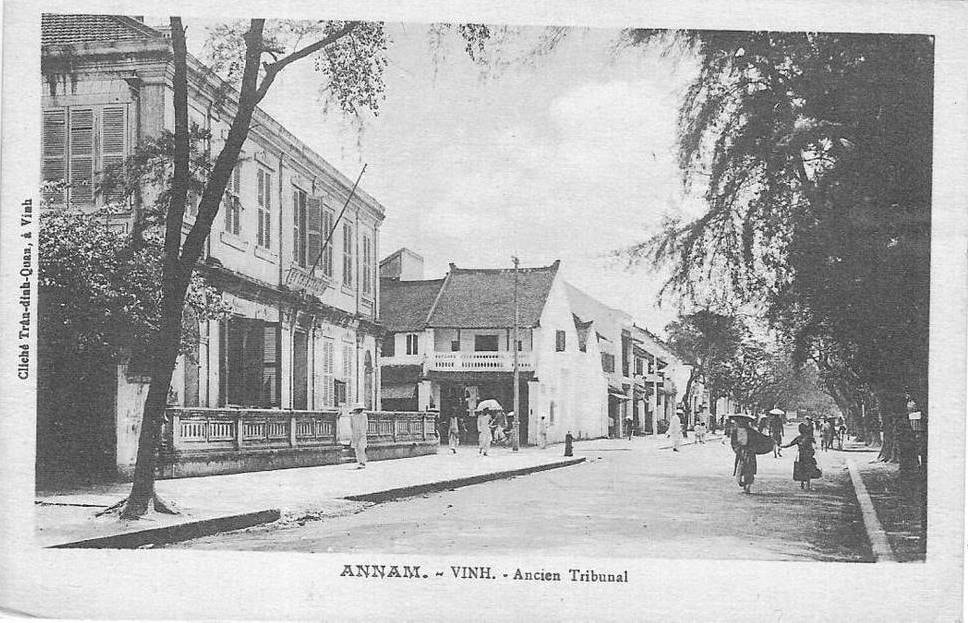 |
| The former Civil Court building (176 Rue Sarrau) was purchased by Vinh Hung Tuong in 1928 to serve as the company's headquarters (currently the location of the Vinh Market Management Board). |
The emphasis on quality of medicine has always been the most important factor contributing to the long-standing reputation of the Vinh Hung Tuong brand throughout Vietnam, both in the South and the North. As a salesperson, Pho Duc Thanh also highly values trustworthiness with customers. In one of his articles, Pho Duc Thanh divided customers into seven categories based on their characteristics and the appropriate way salespeople should interact with each category.
He believed that if customers, regardless of their type, were dissatisfied, it was the salesperson's responsibility. Not only did Vinh Hung Tuong and Pho Duc Thanh create jobs for over 30 people at the headquarters and hundreds more at branches, but they also sponsored, presided over, organized, and managed charitable activities at the Tap Phuc Association, the Duc Anh Association, the Poorhouse, activities promoting the national language at the Vinh Temple of Literature, and famine relief efforts in 1945…
Not only did he research and apply existing remedies, but Pho Duc Thanh was also one of the first Vietnamese physicians to passionately collect, discover, and research medicinal plants and promote their cultivation. In the 1930s, he made numerous expeditions to western Nghe An province to find medicinal plants and also established a medicinal plant garden at the Vinh Temple of Literature.
In particular, he researched many remedies and formulated several effective medicines from Vietnamese herbs. Among them, the most notable is Vinh Hung Tuong balm, named "Van Ung." Initially, Van Ung was just a liquid ointment, but later a thicker balm was added, and the product range was diversified according to the seasons. Later, after working at the Ministry of Health, Pho Duc Thanh transferred the Van Ung balm formula to the Central Pharmaceutical Enterprise No. 2. From there, this product developed into the famous "Cao Sao Vang" brand, renowned both domestically and internationally. It is known that he never received any "royalty" for this invention.
However, what truly established Pho Duc Thanh's reputation and prestige in the field of traditional medicine was his tireless dedication and willingness to face danger for the preservation and development of traditional medicine in his country. During the French colonial period, the government's policies not only discouraged traditional medicine but also sought to tightly control and gradually suppress it.
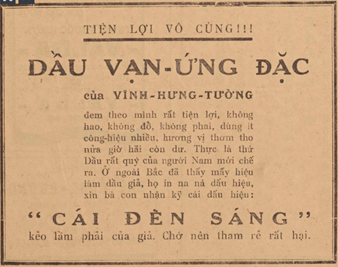 |
| An advertisement for Van Ung special oil, the predecessor of Sao Vang balm, appeared in the Thanh Nghe Tinh Tan Van newspaper on August 10, 1934. |
In that context, from 1930 to 1943, Pho Duc Thanh wrote numerous articles on traditional Vietnamese medicine in both Vietnamese and French, published in various newspapers. Beyond writing, he seized every opportunity to promote traditional medicine, such as bringing medicinal plants and herbal remedies to trade fairs; cultivating relationships with French officials to influence their understanding of traditional medicine… Most importantly, he devoted all his efforts to establishing an organization for practitioners of traditional medicine. Upon acquiring a new office in 1928, Pho Duc Thanh dedicated a separate room to serve as the meeting place for the "Traditional Medicine Association," bringing together renowned and virtuous traditional medicine practitioners in the region. From 1928 to 1936, he persistently and diligently prepared the necessary groundwork for the establishment of the Central Vietnam Traditional Medicine Association.
In 1936, the Central Vietnam Medical Association was officially established, and physician Pho Duc Thanh was nominated to hold the position of permanent manager of the association. This title required approval from the Protectorate government.
The Association published a Traditional Medicine Journal, opened Traditional Medicine classes, and established a clinic… The Association had its own headquarters. A few years later, it even rented a spacious two-story building on Cua Ta Street in Vinh City. The Association also owned its own car and had a substantial budget. All of this was thanks to the great efforts and skillful management of Pho Duc Thanh.
Later, Phó Đức Thành tirelessly campaigned in the North to establish the Northern Medical Association and in the South to establish the Southern Medical Association. On July 17, 1943, the Decoux government issued a decree on management, which was essentially a ban on traditional medicine. Phó Đức Thành continued to write many articles expressing his view that "Such prohibitions and restrictions are unreasonable." He also traveled extensively, meeting with many influential French officials in the Western medical field to lobby for support. Finally, his tireless efforts paid off: the Decoux government had to abolish the aforementioned decree.
After the August Revolution, Phó Đức Thành participated in many social activities. He was a representative of the Vinh City People's Council (1945-1947). In 1954, he became a Standing Member of the Executive Committee of the Fatherland Front of Inter-Region 4. On February 4, 1956, he also held the position of Chairman of the Fatherland Front Committee of Vinh - Bến Thủy town. In December 1956, he was transferred by the Ministry of Health to work in the field of Traditional Medicine, promoting the establishment of the Vietnam Traditional Medicine Association. He died in 1968 in a tragic traffic accident while on a work trip to Cao Bằng.
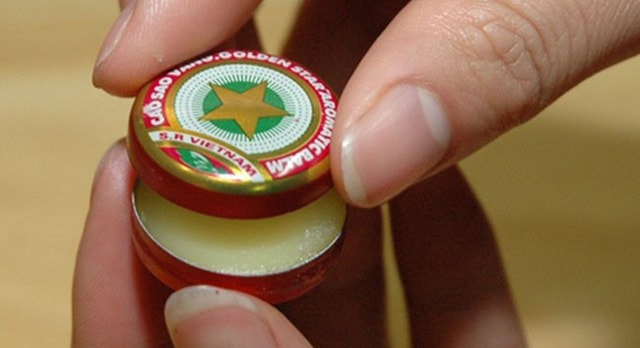 |
| Cao Sao Vàng is a product of Traditional Medicine Practitioner Phó Đức Thành. |
Throughout his active life, physician Pho Duc Thanh spent 30 years in Vinh City. This was also the period when his career flourished in all fields. It can be said that Pho Duc Thanh was a distinctive figure of Vinh City in the first half of the 20th century.
"A patriotic intellectual and renowned physician of the 20th century" is the title that Dr. Nguyen Xuan Huong, President of the Central Committee of the Vietnam Traditional Medicine Association, bestowed upon Pho Duc Thanh.
After 1975, Vietnam and the Soviet Union intensified trade. Cao Sao Vang balm was one of the products exported to the Soviet Union. Production was entrusted to five pharmaceutical factories. The factory in Da Nang alone was assigned an annual production target of 10-15 million boxes. The peak was in 1983, with an assigned production of 20 million boxes, while the lowest was in 1986, the last year with a production target, at 4 million boxes.
After exports to the Soviet Union ended, consumption of Sao Vang balm declined. Many companies registered to produce Sao Vang balm; however, few businesses were able to maintain stable production levels. In addition to the domestic market, businesses sought to sell their products in foreign markets such as Russia and Germany.
After a period of stagnation due to competition from similar products like balm and eucalyptus oil in the domestic market, in 2013-2014, Sao Vang balm was mentioned again as it became a best-selling item in the international market. On leading online sales platforms, this product was priced dozens of times higher than its original price in Vietnam.
 |


