
The start of the new school year marks the beginning of a journey filled with anxiety.
As the new school year begins, many parents are once again worried about excessive fees and the widespread practice of private tutoring.
Today (September 5th), millions of students from preschool to high school are celebrating the opening day of the 2016-2017 school year. The new school year officially begins, however, many schools have already started classes a month ago.
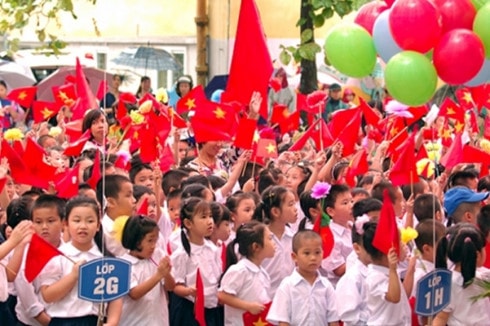 |
| Students are joyful on the first day of school. |
After years of elaborate and costly ceremonies that particularly tired students, this is the second year that the opening ceremony has been organized in a streamlined manner, cutting down on many formalities, especially the welcoming of guests and lengthy speeches by officials… which the students hardly understood. This streamlined and dignified approach to the opening ceremony has been well-received by many parents, students, and teachers. A strong commitment throughout the entire system has ensured that the opening ceremony is concise yet meaningful throughout the school year, and especially leaves a deep impression on the students in the first grade.
However, after the opening ceremony, a series of old worries resurfaced in the minds of many parents: excessive fees, widespread private tutoring, and the need to assess and grade students (especially at the primary school level) appropriately. The ongoing educational reforms have left many feeling uneasy because they haven't yet found a suitable model for their country… Parents hope that, just like with the improvements to the opening ceremony, all these long-standing problems will be thoroughly addressed by the education sector.
Regarding tutoring and extra classes, many localities have held numerous meetings and proposed various solutions to curb this situation… but it seems that the task remains quite challenging.
Some argue that if tutoring is voluntary, it cannot be prohibited. It's true that if parents and students have a need for extra tutoring, teachers cannot be forbidden from providing it. However, in reality, the line between voluntary and "compulsory" is very thin.
For academically strong and excellent students, the regular curriculum may not meet their learning needs and proficiency levels, making their need for extra tutoring understandable. However, it's also necessary to consider situations where teachers withhold lesson plans and don't cover the entire curriculum. Without extra tutoring, students wouldn't be able to pass their exams. Such cases are reprehensible and should be prohibited. But who will be responsible for controlling this issue? That's the crucial question.
Furthermore, when teachers don't give extra classes at school, they do so at tutoring centers or private homes. Not to mention, many of these centers are actually "fronts" for educational management agencies?!
The issue of excessive fees at the beginning of the school year seems to be an endless story. These fees, disguised under various pretexts, leave parents with no choice but to pay. Many fees are completely unreasonable, but parents dare not speak up for fear of their children being discriminated against in class. In reality, some students have suffered ostracism from their peers and teachers simply because their parents spoke out against the school's financial irregularities. Most importantly, while the media has reported on this issue extensively, when the authorities investigate, they fail to identify any violating units or individuals. This means that no one is held accountable or punished for the excessive fees.
The issue of evaluating and grading elementary school students according to Circular 30 has been a subject of much debate over the past two years. Teachers complain about being overwhelmed with stacks of paperwork and daily and end-of-year assessments. Parents are unsure of their children's academic progress, making it difficult to provide additional support. Furthermore, at the end of the year, due to inconsistent interpretations of the Circular, each school and locality applies its own standards for rewarding and evaluating students, leading to numerous controversies among students, parents, and teachers alike.
From now on, parents and students will embark on a journey filled with both anxiety and hope.
According to VOV


