
The high school graduation exam must be conducted according to the "4 correct" and "3 not" principles.
The 2024 high school graduation exam will be the last exam to implement the old curriculum based on the current textbooks.
On the morning of June 20th, the Ministry of Education and Training held an online conference on the organization of the 2024 High School Graduation Examination.
The conference, chaired at the Hanoi venue, was attended by the Deputy Minister of Education and Training - Head of the National Steering Committee, Pham Ngoc Thuong, along with representatives from relevant ministries, departments, and agencies.
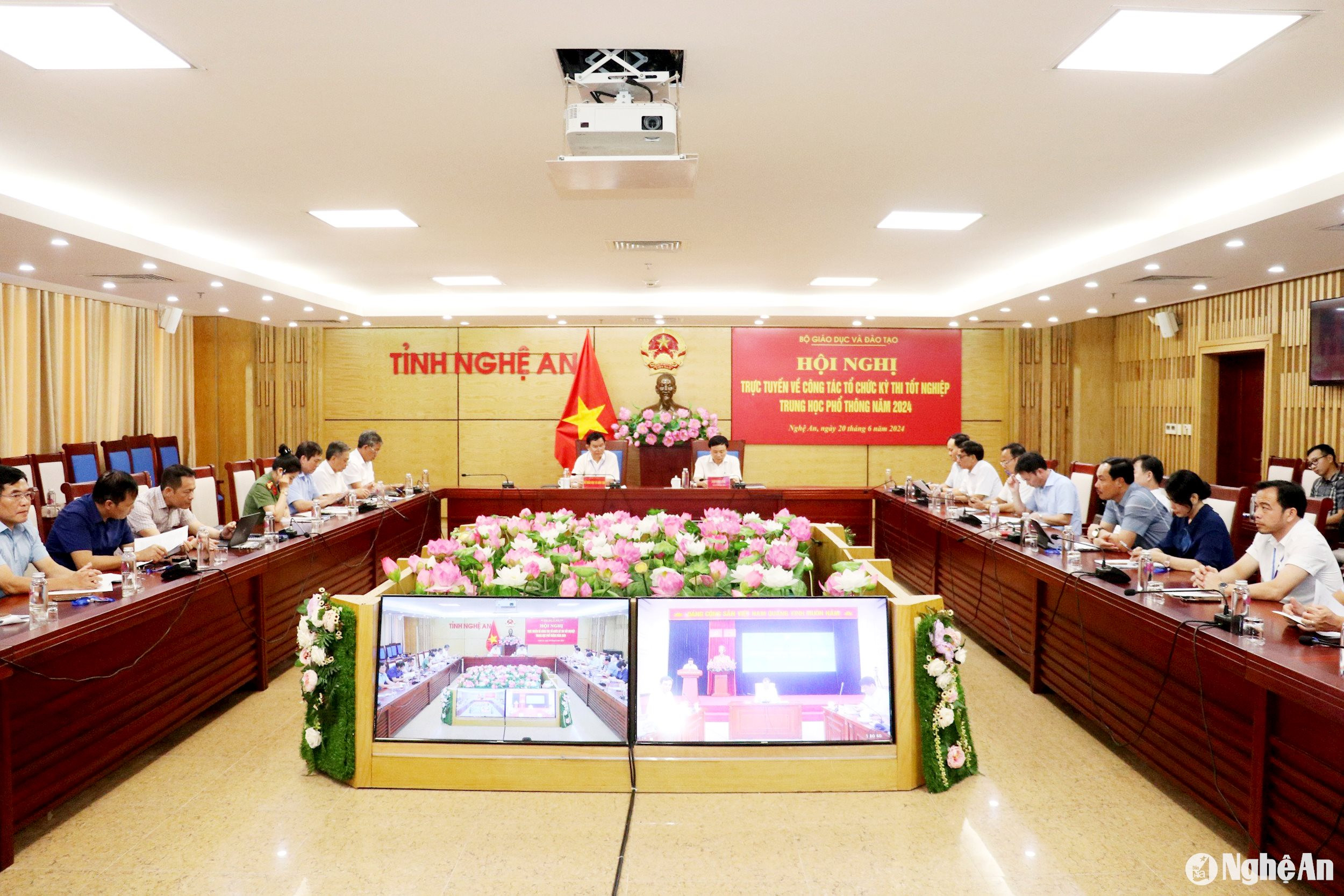
On the Nghe An side, the conference was chaired by Mr. Bui Dinh Long - Vice Chairman of the Provincial People's Committee, Mr. Dao Cong Loi - Deputy Director of the Department of Education and Training, members of the Provincial Examination Steering Committee, and leaders of 21 districts, cities, and towns throughout the province.
The 2024 high school graduation exam is scheduled to be held from June 26-29, 2024. This year, 1,071,393 candidates nationwide have registered to take the exam (an increase of over 47,000 candidates compared to 2023). Of these, more than 46,978 are independent candidates, accounting for 4.38%. There are 2,323 examination centers with 45,149 examination rooms nationwide.
Prior to the high school graduation exam, 66,927 candidates nationwide were exempted from the foreign language exam, accounting for 6.25% of the total number of candidates, an increase of nearly 20,000 compared to previous years.
.jpg)
Regarding this year's exam, at the conference, delegates heard reports from representatives of the Ministry of Education and Training, the Inspectorate, the Ministry of Public Security, and representatives of localities on the implementation process of the exam. Currently, preparations are basically complete; localities have established provincial-level steering committees with all the required components, mobilizing the entire political system and provincial departments and agencies to participate.
In addition, communication efforts were intensified, and proactive preparations were made regarding facilities, equipment, and venues for organizing, supervising, and grading exams in accordance with regulations, ensuring a safe, serious, and rule-compliant examination.
The examination staff were mobilized and given thorough training, ensuring they were familiar with the examination regulations before being assigned to carry out the various stages of the examination.
.jpg)
Concluding the conference, Deputy Minister of Education and Training Pham Ngoc Thuong affirmed that the High School Graduation Examination is a particularly important exam with a wide scale, quick timing, and large scope. It is also an exam of great social interest, evaluating 12 years of study and training for students, serving as a basis for university admissions, and as a foundation for assessing the quality of teaching and learning in schools.
Based on reports from ministries, departments, and localities, the Deputy Minister of Education and Training acknowledged the efforts of local authorities. However, given the high pressure of the exam, Deputy Minister Pham Ngoc Thuong requested that communication efforts be strengthened to ensure accurate, complete, and timely information reflecting the nature and scale of the exam, and to provide warnings and deterrents regarding the use of advanced equipment, dispelling false information and public concerns.
During the implementation process, there must be absolutely no complacency; attention must be paid to every stage of the exam. Officials performing their duties must be self-respecting and conscientious. Students must take the exam honestly, and the results must be genuine.
.jpg)
The Deputy Minister of Education and Training also reiterated four key points and requested that localities seriously implement them: absolute safety and honesty (safety in the printing and transportation of exam papers and answer sheets, safety in fire prevention, traffic, and security and order), timely handling of arising situations (monitoring weather developments, having contingency plans), strengthening responsibility and expertise, and finally, creating the most favorable conditions for candidates to take the exam, especially in difficult and remote areas, ensuring that no candidate is prevented from reaching the exam site due to difficulties.
Furthermore, the implementation process needs to adhere to the "four correct" and "three no's" principles: correct regulations, correct procedures, correct responsibilities and duties, correct timing, and correct procedures for handling unusual situations. Additionally, there should be no negligence or complacency, no independent handling of unusual situations, and no excessive stress or pressure; instead, the approach should be thorough and friendly.
This year's exam, administered by the Nghe An Provincial Department of Education and Training, has 36,956 candidates, an increase of 67. Of these, 1,266 are independent candidates. 2,678 candidates are only taking the graduation exam, and 1,220 are only taking the university entrance exam. The province has 70 examination centers with 1,671 examination rooms, including 73 reserve rooms. Nghe An plans to mobilize 5,906 people to serve as invigilators, with 3,849 specifically assigned as supervisors and invigilators.
At a quick meeting following the online conference, Vice Chairman of the Provincial People's Committee Bui Dinh Long requested that departments and localities strengthen inspection and supervision, paying attention to electricity, traffic safety, and drinking water for students. During implementation, attention should be paid to infrastructure, ensuring at least sufficient fans are available for students. During the examination process, invigilators must strictly adhere to regulations but avoid creating stress or pressure for candidates, preventing unnecessary errors.


