
Recalling the memory of Uncle Ho's first visit to his hometown.
(Baonghean.vn) - On June 16, 1957, after 51 years away from his homeland searching for a way to save the country, President Ho Chi Minh had the opportunity to visit his hometown of Nghe An again. Throughout his years of wandering in search of a way to save the country, the image of his homeland remained deeply imprinted in his heart.
In 1895, at the age of 5, Nguyen Sinh Cung accompanied his father from Nghe An to Hue for the first time. In 1901, after his mother's death, Nguyen Sinh Cung returned to Nghe An with his father and changed his name to Nguyen Tat Thanh.
In 1906, at the age of 16, Nguyen Tat Thanh left Nghe An for Hue for the second time with his father. From there, the young Nguyen Tat Thanh continuously moved south, attending primary school, honing his knowledge of Chinese characters, and learning French; then he participated in teaching and began to join patriotic movements.
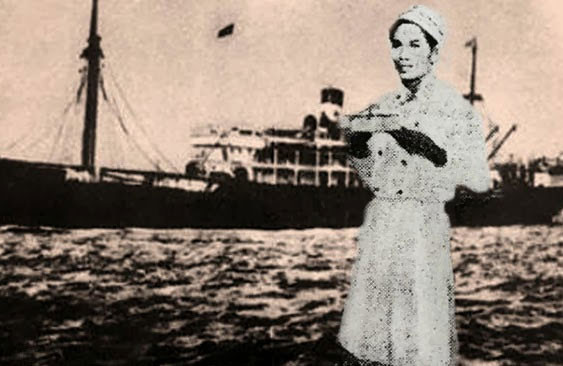 |
| The decision to go to France to find a way to save the country was the first historically significant decision, most clearly demonstrating Ho Chi Minh's independent and creative thinking. |
In 1911, at Nha Rong Port (Saigon - Gia Dinh), Nguyen Tat Thanh, under the name Nguyen Van Ba, boarded the merchant ship Latouche-Tréville as a cook and sailed to France, beginning his journey to find a way to save the country and liberate the nation from feudal and colonial oppression.
In 1941, after 30 years of wandering abroad, Nguyen Tat Thanh, now known as Nguyen Ai Quoc, returned to Vietnam to lead the revolutionary movement; and together with his comrades, successfully directed the August Revolution of 1945, overthrowing the feudal and colonial regimes, liberating the nation, and achieving independence and freedom for the Vietnamese people; establishing the Democratic Republic of Vietnam on September 2, 1945.
In the years that followed, as President of the country, President Ho Chi Minh devoted himself wholeheartedly to the revolutionary cause, working with the entire Party, army, and people to both build and develop the nation and fight against foreign invaders. He still did not have the opportunity to return to visit his hometown of Nghe An.
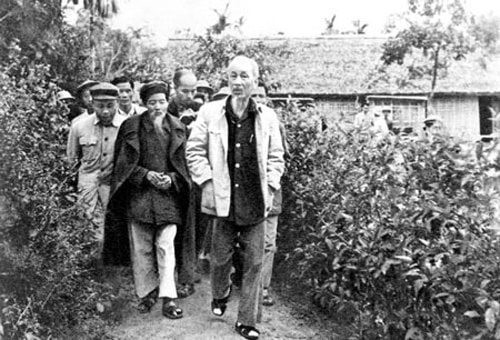 |
| President Ho Chi Minh revisited his old house in Kim Lien village during his first visit to his hometown after 51 years of separation (June 16, 1957). (Archival photo) |
It wasn't until 1957 that Uncle Ho had the opportunity to return to his hometown of Nghe An after 51 years of absence. That was on June 16, 1957. What was particularly special was that when Uncle Ho returned to his hometown, he wasn't doing so in his capacity as President of the country, but simply as a son who had been away for a long time, now returning to his ancestral land, the place where he was born and raised, to visit friends and neighbors with simple, affectionate, and deeply moving feelings.
According to many witnesses, on the morning of June 16, 1957, when President Ho Chi Minh arrived in Nghe An, a provincial leader invited him into the newly built guesthouse, but he refused, saying, "I have been away from home and my hometown for a long time, so I must visit home first. The guesthouse is for receiving guests and for them to stay in. I am family, not a guest!"
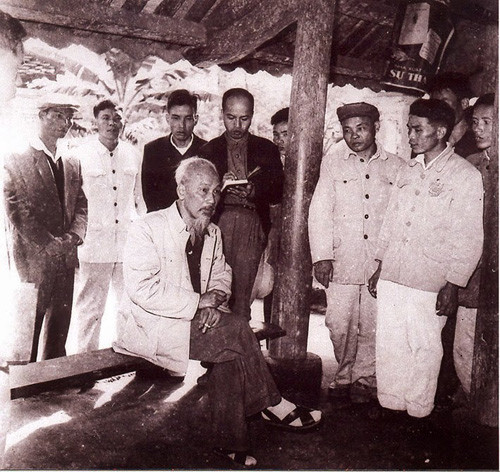 |
| In his old house in Kim Lien village, President Ho Chi Minh was deeply moved as he recalled his childhood memories. (Archival photo) |
Then Uncle Ho returned to Kim Lien village (Nam Dan district), to revisit the old house that the villagers had built for his father, Nguyen Sinh Sac, who held the title of "Pho Bang" (a high-ranking scholar). He stood thoughtfully, surveying the two houses and pointing out to his companions where the guava tree and the pomelo tree had grown in the garden of his former home.
Uncle Ho went into the house, pointing out the location of various objects everywhere he went. Everything remained perfectly preserved in his memory. He then went out into the yard, gazing at the house that had been so closely associated with a crucial period of his life. This house witnessed his labor, studies, and growth; it was where his first feelings of patriotism and social awareness were imprinted, and where his initial activities to save the country began.
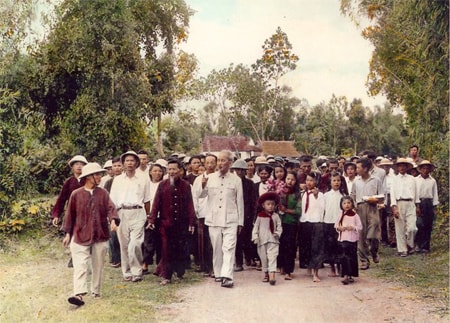 |
| Uncle Ho visited his hometown of Nam Dan, Nghe An (1957) amidst the joyful cheers of his neighbors. (Image from the internet) |
Behind the house, an elderly neighbor came out to greet Uncle Ho and asked, "Do you still remember me?" Uncle Ho patted his forehead for a moment and said, "Is that Dien?" Mr. Hoang Dien ran to embrace his childhood friend, who used to herd buffalo and fly kites, and wept with emotion.
Afterward, Uncle Ho addressed the people, beginning with a poem: "Homeland, a place of profound meaning and deep affection. Fifty years have passed, and how much love there is," in the warm, deep voice of someone from Nghe An province. Uncle Ho reminisced with emotion about leaving his homeland when it was still under colonial rule, and now, upon his return, he was overjoyed to see the country free and the people prosperous.
The President instructed: "Kim Lien strives to become a model commune, and I will come to visit." Many people were moved to tears by the deep love for their homeland in the heart of the leader, even though he had been away from home for more than 50 years.
Before getting into the car, Uncle Ho gave five packets of Ba Dinh tea to the elderly and several packets of Hanoi candy to the children in the village.
That afternoon, President Ho Chi Minh addressed over 3,000 delegates, including officials and citizens of Nghe An province. Delighted by the large gathering of people from all walks of life, he recited the poem: "We are united as one family / That is a profound meaning, that is a deep affection."
Then, Uncle Ho said: "I am a son of this province who has been away from my homeland for more than 50 years. Today is the first time I have returned to visit my home province. It can be said: My homeland holds profound meaning and deep affection / Fifty years have passed, and how much love there is!"
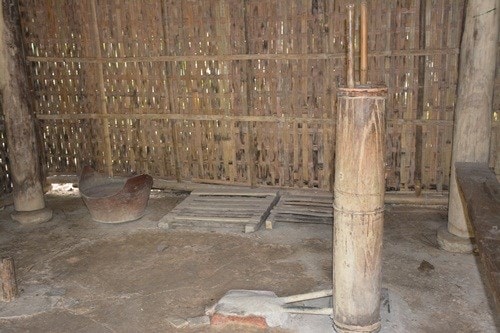 |
| The old blacksmith shop of Co Dien was established by Mr. Hoang Xuan Luyen (commonly known as Co Dien) to forge tools for the local people from the late 19th century. When living in Lang Sen village, Nguyen Sinh Cung (Ho Chi Minh's childhood name) often went to help Co Dien hammer anvils, pump bellows, and collect scrap iron to make toys. |
The President praised the achievements that Nghe An province had made during the 9 years of resistance against French colonialism and in the 3 years of healing the wounds of war and restoring the economy; he also pointed out some shortcomings that the cadres and people of Nghe An needed to overcome, such as not paying enough attention to practicing thrift; and not fulfilling their tax obligations and repaying debts to the State.
Regarding the tasks of the cadres and people of Nghe An, Uncle Ho clearly stated: improving the people's lives is the goal of the Party and the State, but it must be understood that to improve living standards, production must be increased and thrift must be practiced, and it requires time and effort.
The President emphasized several specific tasks that the people and officials of Nghe An must focus on immediately: Correcting mistakes effectively; fulfilling tax obligations and repaying debts to the State; preventing and mitigating natural disasters; promoting unity; developing a traditional and virtuous way of life; and adhering strictly to the laws of the State. At the end of the meeting, everyone sang the song "Unity" in a warm and joyful atmosphere.
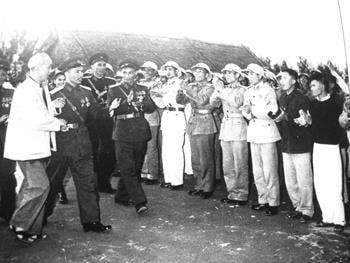 |
| General Chu Huy Mân and officers and soldiers of Military Region 4 welcome President Ho Chi Minh to visit their unit. (Archival photo) |
In the evening, President Ho Chi Minh visited the 4th Military Region Command, where the military's performing arts troupe presented a performance. The organizers arranged two rows of armchairs and two cushioned chairs in front of the stage. Upon entering the hall, with his simple and approachable demeanor, just as he was in his hometown, President Ho Chi Minh placed his sandals down and sat on them. The two rows of chairs were left empty and had to be moved out. During the performance, a female actress recited the poem "Tonight, Uncle Ho Cannot Sleep," which deeply moved him…
On December 18, 1961, President Ho Chi Minh visited his hometown of Nghe An once again. However, the people of Nghe An, especially the people of Nam Dan, still vividly remember the simple, unpretentious, sincere, and touching memories and feelings of President Ho Chi Minh on June 16, 1957, when he first visited his hometown.
Peace
(Synthetic)
| RELATED NEWS |
|---|


