
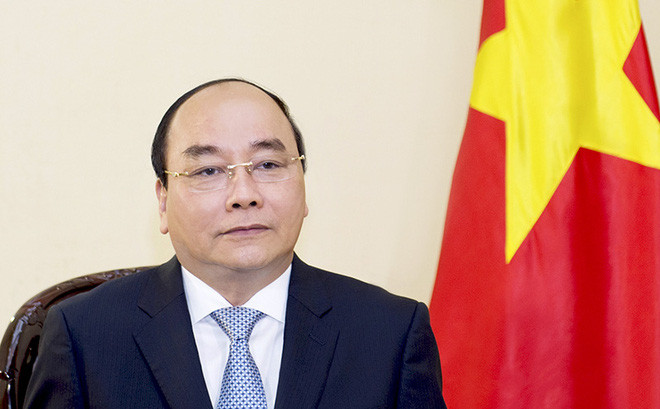
Prime Minister Nguyen Xuan Phuc gives an interview on Vietnam-Australia relations.
Prime Minister Nguyen Xuan Phuc recently gave an interview to Fairfax Media on the cooperative relationship between Vietnam and Australia, especially in the new context of both countries participating in the Comprehensive and Progressive Trans-Pacific Partnership Agreement (CPTPP).
|
| Prime Minister Nguyen Xuan Phuc. Photo: VGP |
Mr. Prime Minister, since 2015, both Vietnam and Australia have indicated their intention to establish a Strategic Partnership. Could you please tell us when this event will take place and what its significance is for bilateral relations? Could you also share some measures aimed at promoting diplomatic and defense relations between the two countries?
Prime Minister Nguyen Xuan Phuc:This is a commitment shared by both Vietnam and Australia. During this official visit to Australia, Prime Minister Malcolm Turnbull and I will sign a Joint Declaration establishing a Vietnam-Australia Strategic Partnership, creating a political and legal framework to elevate bilateral relations in the future.
Upgrading relations to a Strategic Partnership is of great significance, opening a new chapter in bilateral relations, elevating the relationship to a new level, and deepening cooperation in a substantive way, serving the interests of the people of both countries, while contributing to peace, stability, cooperation, and development in the region and the world. This event is particularly significant as both countries are celebrating the 45th anniversary of the establishment of diplomatic relations and the 20th anniversary of the establishment of defense relations.
To develop the relationship to a level commensurate with its strategic nature, the two countries need to continue strengthening and expanding cooperation in all areas. Specifically in the political-diplomatic and defense-security pillars, the focus should be on the following:
The first,Vietnam continues to strengthen political trust and mutual understanding through visits and contacts at all channels and levels, especially visits by high-level leaders. In that spirit, Vietnam welcomed the visit of the Governor-General of Australia to Vietnam in May 2018 and considered it an important foreign affairs activity of 2018. At the same time, it will review and promote the effective implementation of existing bilateral cooperation mechanisms, and on that basis consider upgrading or establishing new mechanisms for exchanging and consulting on important, strategic bilateral, regional, and international issues.
Monday,Closely coordinate at regional and international forums, especially ASEAN, APEC, ASEM, the United Nations, etc.; effectively implement the Comprehensive and Progressive Trans-Pacific Partnership Agreement (CPTPP); and strengthen cooperation on issues related to regional security and common concerns such as poverty reduction, disaster and disease prevention, climate change response, and the achievement of sustainable development goals.
Tuesday,Regarding defense and security, both sides need to actively implement diverse cooperation in many fields according to the agreements reached; maintain the effectiveness of cooperation mechanisms; expand cooperation in the fields of search and rescue, counter-terrorism, anti-human trafficking, cybersecurity, and water security; and actively consult and support each other in regional cooperation mechanisms on defense and security such as ADMM, ADMM+, ARF... Vietnam highly appreciates and hopes that Australia will strengthen the exchange of experience, share information, and support Vietnam in English language training, training of forces participating in peacekeeping and post-war remediation.
Among ASEAN countries, Vietnam is becoming the fastest-growing export market.AustraliaMr. Prime Minister, could you please share your assessment of the opportunities for businesses?Australia?
Prime Minister Nguyen Xuan Phuc:Economic, trade, and investment relations between Vietnam and Australia have seen strong development in recent years. Currently, Australia is Vietnam's eighth largest trading partner, with trade turnover reaching nearly US$6.5 billion in 2017. However, the potential for cooperation between the two countries and opportunities for Australian businesses to operate and invest in Vietnam remain enormous.
The firstVietnam is a dynamic developing economy with a high growth rate in the region. In 2017, the Vietnamese economy grew by 6.81%, the highest in the last 10 years. Combined with its strategic geographical location in the region, political stability, a market size of nearly 100 million people with an average income of US$2,400 per person and growing, Vietnam is an attractive destination for foreign investors.
MondayWith a strong commitment to accelerating economic reforms and innovating the growth model, the business and investment environment in Vietnam is steadily improving. Many economic indicators, such as the Business Environment Index (DB 2018 by the World Bank), which rose 14 places, and the Global Competitiveness Index (GCI 2018 by the World Economic Forum), which rose 5 places, are creating an attractive, transparent, and level playing field for foreign businesses.
TuesdayAs a highly open economy with trade turnover reaching US$425 billion in 2017, equivalent to 190% of GDP, Vietnam is undergoing deep and comprehensive integration. Vietnam is currently implementing and negotiating 16 free trade agreements (FTAs), including many new-generation FTAs, opening up many new opportunities for cooperation between Vietnam and its partners, including Australia. The joint implementation of the ASEAN-Australia-New Zealand FTA and the signing of the CPTPP Agreement on March 8, 2018, will help facilitate trade and investment flows between the two countries.
In this context, establishing a Strategic Partnership will bring new opportunities for businesses in both countries. With advantages in capital, advanced technology, and management experience, Australian businesses can take advantage of this opportunity to expand their business and invest in Vietnam in areas where Australia has strengths and Vietnam has needs, such as high technology, manufacturing, processing, and environmentally friendly energy.
Vietnam is one of the main beneficiaries of the TPP.but some of those benefitsarrivefrom economic reforms to meeting the high standards of the original agreement.However, the US withdrew from the TPP, which resulted in a new agreement with generally lower standards than the original. So, Prime Minister, could you please tell us whether Vietnam will continue to propose economic reform plans?
Prime Minister Nguyen Xuan Phuc:Economic reform is a crucial policy and a necessity for innovation and development for Vietnam, whether or not the TPP is in place.
Despite the absence of the United States, the CPTPP remains a new-generation FTA with high standards, significant openness, balanced benefits for all parties, and a comprehensive and progressive nature. It serves as a "model" for regional economic cooperation and integration in the context of protectionism appearing in many parts of the world.
We believe that participation in FTAs, including the CPTPP, will create further impetus for reform. Therefore, in the coming period, we will accelerate economic restructuring, improve the legal and policy framework, and create a level playing field and a favorable business environment, coupled with the serious and full implementation of commitments on trade liberalization and facilitation, and market opening.
NOn the occasion of attending this ASEAN-Australia Special Summit, could the Prime Minister please share his assessment of the potential for the future development of the ASEAN-Australia Strategic Partnership?
Prime Minister Nguyen Xuan Phuc:Following the upgrade to a Strategic Partnership in 2014, ASEAN-Australia relations have been strengthened across many areas, from political-security, economic-trade-investment to cultural-social and development cooperation. However, there is still significant room and potential for ASEAN-Australia cooperation, especially in the following areas:
The firstASEAN and Australia need to continue to affirm their strong commitment to maintaining economic linkages in the region. Accordingly, they should effectively implement the ASEAN-Australia-New Zealand Free Trade Agreement (AANZ FTA), a comprehensive framework with a high level of liberalization that ASEAN has signed with its partners for the first time, and in the future, the Regional Comprehensive Economic Partnership (RCEP).
MondayIn the era of the Fourth Industrial Revolution, economic development based on innovation plays a key role. Both sides need to further strengthen cooperation in areas such as startups, connecting small, medium, and micro enterprises, and contributing to the diversification of regional and global value chains...
TuesdayBoth sides share views on many strategic issues, thus enabling them to strengthen cooperation, build trust, and jointly create an open, transparent, and inclusive regional architecture. Cooperation forums chaired by ASEAN with partners, including Australia, serve as important frameworks to promote these efforts.
WednesdayCooperation in responding to non-traditional challenges such as terrorism, extremism, natural disasters, epidemics, and climate change are areas where ASEAN and Australia have common interests and need to be promoted with the goal of bringing peaceful and safe lives to their people.
I am confident that, building on the solid foundation of cooperation established over more than four decades, we can continue to expand and deepen the ASEAN-Australia Strategic Partnership in the coming period.
Thank you, Mr. Prime Minister!

