
Controversy over abolishing the national high school graduation exam.
Abolishing the national high school graduation exam; not abolishing the graduation exam; organizing graduation assessments; organizing university entrance exams... these are some of the conflicting opinions from many education experts suggesting reforms to next year's exams.
At the press conference concluding the 2016 National High School Graduation Examination, Deputy Minister of Education and Training Bui Van Ga stated that organizing examination clusters in all provinces and cities nationwide can be seen as an important test to continue reforming the examination/admission process to make it smoother and more effective in the coming years.
The Ministry will soon organize workshops to gather broad public opinion to decide on the method of organizing the exam in the following years. All feedback from society and the press will be taken into account, and solutions will be developed as soon as possible.
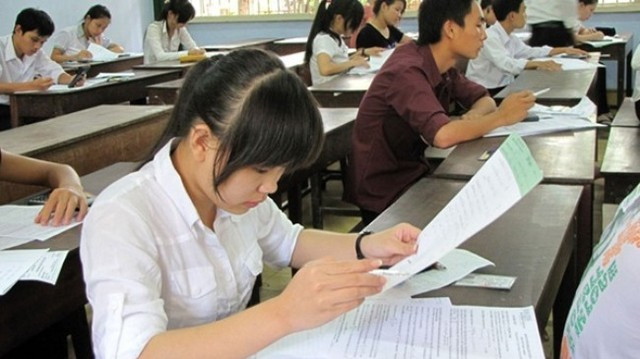 |
Bring the high school graduation exam back to the local level.
Associate Professor Dr. Le Trong Thang from the Hanoi University of Mining and Geology believes that any proposed examination method has its advantages and disadvantages, therefore we must choose the most suitable option.
"My view is not to abolish the high school graduation exam, but to entrust the organization of the annual graduation exam to local authorities, as this is a normal assessment of students' learning process at the high school level. Organizing it this way would be appropriate to the learning level and teaching and learning conditions in each locality. The Ministry of Education and Training sets minimum quality requirements. This method of organization also motivates localities to continuously improve the quality of teaching and learning in their areas," Mr. Thang stated.
Regarding the 2017 exam, according to Mr. Thang, too many changes should be avoided because in education, changes should be limited in the short term, and shortcomings should be addressed. Rapid changes like the current ones create negative psychological effects on students, causing fatigue, and leading public opinion to believe that the education sector is constantly using students as guinea pigs.
Regarding whether the graduation exam should be based on assessment or examination, Mr. Thang stated that the examination method should adjust the way of learning and teaching. Learning must be tested, not abandoned. The examination must reflect the true nature of learning and accurately assess the students, not just focus on achieving a 98 or 99% graduation rate.
Sharing the same viewpoint, Associate Professor Phan Quang The, Rector of Thai Nguyen University of Technology, stated: “Learning must involve exams; exams are mandatory at every level of education, from primary school to university. The method of the exam is not important, but the foundation of learning is exams. Here, we shouldn't talk about the hardships or pressure faced by students. Education is about training, and it must involve pressure and challenges. We cannot revert education to a state of 'easy play,' otherwise, what is the point of talking about education?”
University entrance exams should be organized.
Associate Professor Dr. Le Huu Lap from the Posts and Telecommunications Institute of Technology believes that the national high school graduation exam should be abolished. He suggests that the provincial Departments of Education and Training should organize the high school graduation exam and obtain exam questions from the Ministry of Education and Training. He also argues that exams for selecting and training high-quality talent should be organized by universities.
"The goals of the competitions are different. The university entrance exam is to select outstanding students, while the high school graduation exam is to achieve a certain threshold for graduation, like a relaxed final exam," Mr. Lap said.
According to Mr. Lap, a university entrance exam should be organized because the current exam system fails to select talented individuals. The exam, with 60% of the questions covering graduation and 40% covering university entrance, is inaccurate and makes selection very difficult. This classification is problematic because a difference of 0.25 points in social science subjects can determine pass or fail. Meanwhile, the university entrance exam is very fair, allowing only truly excellent students to enter. High school students already undergo rigorous annual assessments and classifications, allowing them to progress to the next grade in a sequential manner.
Regarding university entrance exams, Mr. Lap suggested establishing an independent testing center. This center would assist universities in organizing exams for candidates. Universities could choose to use the center's results, while others could use academic transcripts instead.
"The Ministry of Education and Training is a state management agency and should not get bogged down in organizing exams. The Ministry must formulate policies and guidelines, and conduct inspections and supervision to ensure the development of education and social equity in the field of education," Mr. Lap said.
Previously, in an interview with the press, Professor Hoang Tuy stated that the national high school graduation exam has truly been reformed. Thanks to its foundation on the correct understanding of examinations, the exam is organized efficiently, economically, minimizes risks for candidates, and creates conditions to promote teaching and learning in a healthy, progressive, and positive direction.
Regarding the concept of learning and examinations, Professor Hoang Tuy believes that examinations are a way to check the quality of learning, and graduation exams are the final checks of training quality before graduation. It's similar to checking a factory's products before they are shipped out.
Regarding the use of the national high school graduation exam results for university and college admissions, Professor Hoang Tuy believes that while the old exam system with three separate rounds might have been easier for universities, it was unnecessarily stressful and costly for students and society. Now, combining everything into a single exam naturally makes the admissions process more complex, but it reduces stress for students and saves a lot of effort and money. Therefore, the price paid to alleviate this burden for students and society is not unreasonable.
However, Professor Hoang Tuy argues that the problem lies in the fact that the high school graduation exam and the university entrance exam have very different requirements, making it difficult to combine them into a single exam. If done poorly or incorrectly, it could be even more detrimental than keeping the two exams as they are.
The Ministry of Education and Training needs to listen to public opinion regarding the limitations and shortcomings of the reformed exam in order to learn from experience and create an even better exam next year.
According to Dantri


