
Mon Son Commune (Con Cuong District): Breakthrough in economic restructuring
(Baonghean) - Mentioning Mon Son (Con Cuong) brings to mind a prosperous rural area, rich in revolutionary traditions and cultural identity. The people of the Thai, Dan Lai, and Kinh ethnic groups are gradually rising up, building a more prosperous life every day.
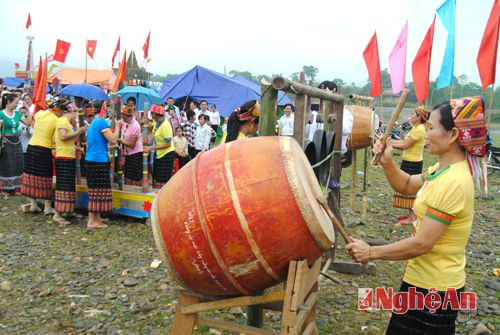 |
| Festival in Mon Son (Con Cuong). |
Visiting Mon Son on a late May day, when farmers are entering the spring rice harvest season, the Muong Qua rice fields are a golden hue of ripe rice. All the roads are bustling with trucks carrying rice home, and the villages resound with the sound of threshing machines. In the courtyards, the elderly and children spread out the rice to dry; it's harvest season, so everyone has a task to do...
In the spring of 2015, Mon Son commune planted approximately 360 hectares of rice, mainly hybrid varieties. Thanks to the application of scientific and technical advancements in production and cultivation, and investment in the construction of an irrigation system, this year's spring rice crop grew well, achieving relatively high quality, with an average yield of over 56.4 quintals/hectare. With the success of the spring rice crop, farmers in Mon Son commune are truly reassured, as their food supply for the year is basically met. Ms. Vi Thi Tan, a farmer in Cang village, shared: “This year the rice crop is abundant, and the sunshine has made drying very easy. Every house is full of rice, everyone is happy, and this year there is no longer any worry about hunger…”
Leaving the Muong Qua fields, we visited the villages of Mon Son, where ancient stilt houses peeked out from under palm trees and old-growth trees. The road to the village is now much easier to travel than before, no longer rough and bumpy but paved smoothly with concrete. This is the result of the new rural development program being actively implemented in this remote area. The village of Xieng, famous for its brocade weaving and having established a handicraft cooperative nearly 10 years ago, is also busy with the harvest season. Despite this, the women of Xieng village still take advantage of their free time to weave fabric, as the delivery deadline is approaching. While not their main occupation, brocade weaving has provided the women of Xieng with a significant additional income, earning nearly 1 million VND per worker per month to support their families. In a conversation with Ms. Ha Thi Hang, Head of the Handicraft Cooperative, we learned that many partners have approached them to place orders and process goods, so work will likely increase and income will be higher in the near future. The village of Xieng has been designated a "Community Tourism Destination" by UNESCO, which is also an important direction for the women in the village to sell their traditional brocade products.
Not far from Xieng village is Cang village, known for its excellent work in preserving and promoting the cultural identity of the Thai ethnic group. The village's folk song and musical instrument club has been established for nearly 10 years and has recently been recognized as a model at the provincial level. When the farming and fieldwork are finished, Cang village resounds with the sounds of gongs, flutes, pipes, and the melodies of lam and nhuon. Tourist groups, after enjoying the scenery, often visit Cang village to enjoy local specialties and experience the beauty of its customs, traditions, and unique cultural and spiritual life.
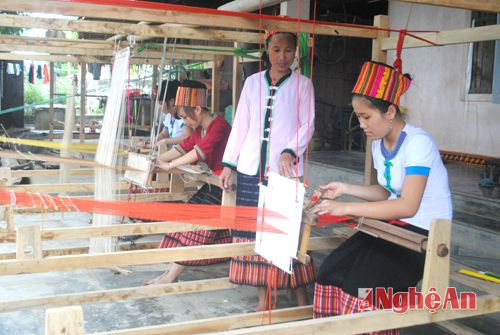 |
| Traditional brocade weaving of the Thai ethnic group in Mon Son commune. |
From Cang village, down to Thai Son, Nam Son, Bac Son, Tan Son, Cua Rao, Thai Hoa, and Lang Yen, one can feel the positive changes everywhere... The Dan Lai people, who resettled from Khe Khang in Tan Son and Cua Rao villages, have begun to stabilize their lives. They are gradually getting used to new ways of doing business, and their level of awareness is improving. The road from the commune center, running along the Giang River to Co Phat and Khe Bung villages, is being built with government investment. In the not-too-distant future, the lives of the Dan Lai people upstream of Khe Khang will change significantly; with the road, economic and social exchange will be easier and more convenient, and electricity will soon illuminate the villages... All of this contributes to the transformation of a revolutionary homeland, affirming the resilience and determination of the cadres and people in this border region.
For a long time, Mon Son - Muong Qua has been known as a region rich in tourism potential, especially ecotourism and community tourism. The majestic and picturesque Mon Son mountains, the Pu Mat primeval forest, the romantic Giang River with its famous "ca mat" fish, and the poetic Pha Lai scenic spot. The Thai people in Mon Son still preserve their unique cultural identity, including customs, traditions, traditional crafts, and dishes that reflect the flavors of the mountains and forests. The folk song "Rice from Muong Qua, fish from the Giang River" has been passed down through generations and is a source of pride for the people of Muong Qua. Developing tourism will help the people of Mon Son utilize their natural endowments to generate additional income and improve their lives.
In an exchange ahead of the 26th Party Congress of Mon Son commune (2015-2020 term), Comrade Vi Van Nam, Secretary of the Party Committee of Mon Son commune, affirmed: “In the coming term, Mon Son will continue to rely on the foundation of revolutionary traditions, maximize internal resources, promote economic development, create breakthroughs in economic restructuring, build a clean and strong Party Committee, and gradually achieve the goal of building a new rural area.”
Tuong Anh


