
New startup trends in Nghe An
(Baonghean.vn) - Recently, Nghe An has seen the emergence of many startup models in agricultural industrial production, affirming the efforts of young entrepreneurs to rise up, suggesting solutions for development, exploiting strengths from local plants and animals, and producing in a safe manner…
Achieving boldness and taking action.
The first product we want to mention is honey from the Group Joint Stock Company, under the brand name "Bometa". Nguyen Van Hoc – the company's director – said that the name is not English or an international designation, but a word from Nghe An, reflecting the aspiration that each product is a loving gift from children to their parents, whom the people of Nghe An often call "our parents". Starting from scratch and after nearly 10 years of learning and working, with many setbacks and failures, but thanks to his determination, Hoc now has a collection of 29 products, including 11 products that have achieved OCOP 3-star standard and 4 products that have achieved OCOP 4-star standard; the company's products are distributed by 56 provincial distributors and have entered pharmacies and clean food chains.
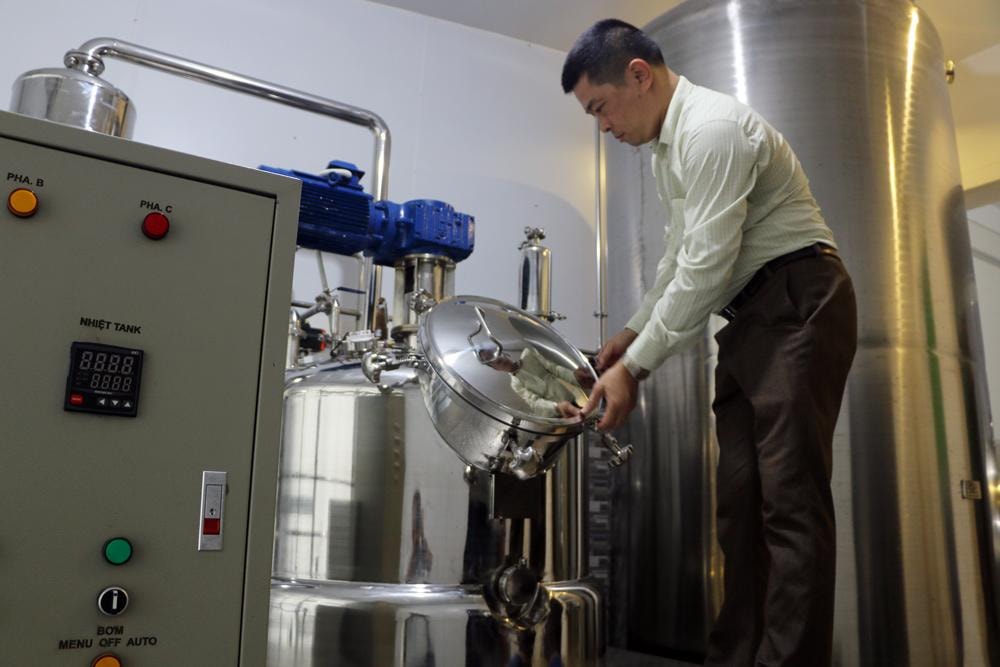 |
The honey refining line of Bometa Group Joint Stock Company is currently having its application processed by the Nghe An Center for Consulting Services and Industrial Promotion to receive support from the National Industrial Promotion program. Photo: Nguyen Hai |
Based primarily on refined honey, Hoc processes and produces health-supporting products such as agricultural food supplements and herbal teas. To enter this demanding market, Hoc adheres to strict standards.organic production according to organic standardsFrom American-made farms to production and processing lines, safety is guaranteed. From seemingly discarded herbal plants in rural areas, the processing line transforms them into teas and beverages that detoxify the liver and cleanse the body.
In a conversation with us, Hoc further explained: Producing herbal tea is both easy and difficult. It's easy because ingredients like honey and native plants and leaves from our tropical climate are readily available, but it's difficult to control them according to safety and organic production standards. For example, with honey, to ensure a reliable source, Hoc surveyed and ordered from 48 stable bee farms nationwide, and the company only purchased after monitoring for 6 months if the quality met the standards… Thanks to persistently applying these criteria, the company's product quality dossier was inspected and recognized by the provincial authorities and the Intellectual Property Office.
The second model is that of young startup founder Dang Thi Tam, An An Agri Joint Stock Company in Dien Thanh commune, Dien Chau district. Born and raised in the rural area of Dien Chau, Tam often pondered why, despite the hard work of farmers, agricultural products always fetch low prices during bumper harvests; why clean and unclean products are mixed together on the market and sold at the same low price.
Based on this idea, in 2015, Tam decided to start a business producing safe, organic fruits and vegetables. Initially, with only 100 million VND in capital, Tam decided to produce safe vegetables for the Vinh City market, as it was a large and demanding market in Nghe An province. However, after a period of distribution, realizing that although the quality of the fruits and vegetables was good, they were mostly packaged and processed in a rudimentary way, resulting in bulky goods, high transportation costs, and low value, Tam decided to shift towards refined processing.
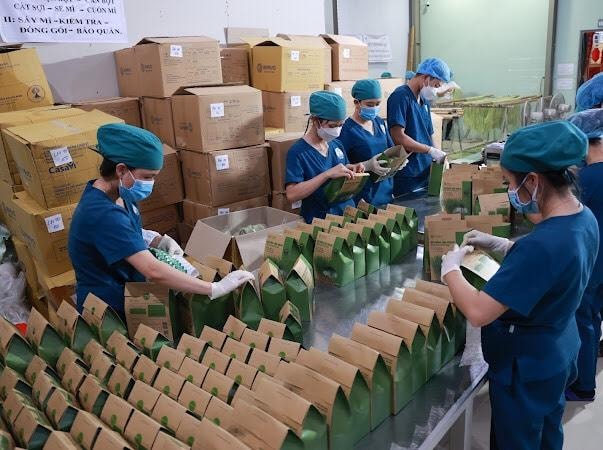 |
Packaging of fruit-flavored instant noodles at An An Agri Joint Stock Company in Dien Thanh commune (Dien Chau district). Photo by contributor Sach Nguyen. |
Realizing that instant noodles are a favorite food of most Vietnamese people, Tâm noticed that while local white rice noodles produced by farmers are quite inexpensive, processing them into clean vegetable and fruit noodles for dieters in supermarkets can fetch prices ranging from 250,000 to 1 million VND per kilogram. Coincidentally, during a trip to a clean vegetable and fruit fair in the North, Tâm's farm's cabbage and tomatoes were sampled by a Japanese culinary expert who was impressed. Following further introductions, the expert decided to visit the farm to see the model. From then on, after several interactions, Tâm received guidance on the technical process and technology transfer from the expert…
With the support of family and colleagues, in 2019, Tam's fruit-flavored instant noodles were launched. Building on the foundation of fruit-flavored instant noodles, the company produces dozens of product lines, including prominent ones like barley sprout noodles, beetroot and radish noodles, turmeric noodles, and ginseng vegetable noodles… The products have now reached 90% of the domestic market through major supermarket chains and are exported to other countries. Given its current position, the company could set up a factory anywhere, but Tam wants to establish the brand name of his products in connection with the local plants and animals that have made the brand so unique. By achieving this, Tam has fulfilled the encouragement of a Japanese expert: "Whatever the world can do, the Vietnamese, and especially the people of Nghe An, with their intelligence and creativity, can also do."
Solutions to help young startups in Nghe An reach greater heights.
These are just two of the dozens of successful startup models from rural industries in Nghe An. Currently, the province also has major products and brands such as herbal tea, lotus-infused tea sets, turmeric starch, etc.
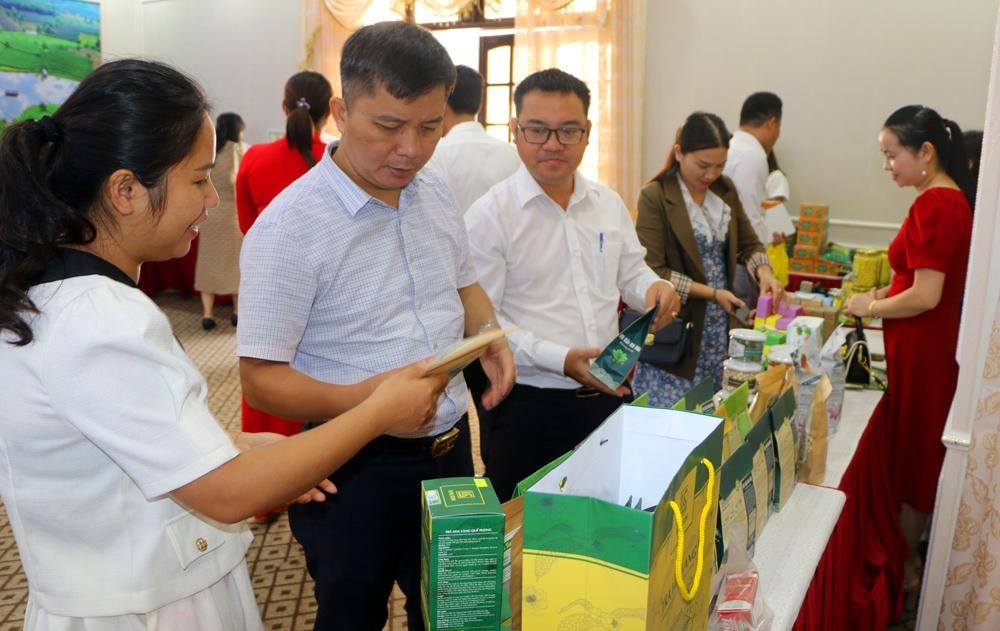 |
OCOP products, produced using safe organic methods by young startups in Nghe An, were showcased at the Nghe An-Quang Tri Industrial and Trade Product Supply and Demand Connection Conference. Photo: Nguyen Hai |
The entrepreneurial journey and success of these startups, alongside the efforts of each individual, also bears the mark of the province's support and companionship through the National Industrial Promotion Center, the Provincial Industrial Promotion Center, and the Center for Applied Science and Technology. Depending on the scale, each model receives nearly 1 billion VND in support. Compared to the value of the production line invested by the businesses, this support is not large, but it is a necessary encouragement and boost for these startup models to thrive. However, alongside the initial successes, there are still many difficulties.
Currently, health-related beverages and food products should be strictly managed and monitored; production must follow organic VietGAP and GAP standards.globalGAPIf it's organic, the opportunities will be greater. Thanks to this approach, these models have established their brands in the market, but taking off and expanding further is not easy.
Nghe An is one of the provinces that produces a large amount of honey in the country, but in reality, many honey samples do not meet standards, making it difficult to purchase. To ensure safety and compliance with standards, besides their own chain of bee farms, only establishments that produce honey under their own conditions dare to import it.
Similarly, after convincing Japanese experts, Tam was presented with a great opportunity when he received a request to supply 20 containers of vegetables and fruits per month, but he didn't dare accept it because passing food inspections in other countries is not easy. Tam's noodle production ingredients are also sourced only from vegetables and fruits grown by his company and from some leased land from farmers because growing or buying from outside requires testing every 15 days, and returning substandard goods would be extremely disadvantageous.
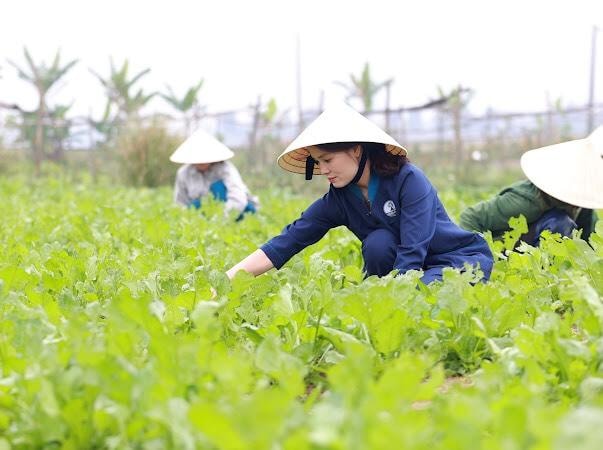 |
Organic vegetables are grown for use in making fruit noodles in the raw material area of Dien Phuc commune (Dien Chau district). Photo: Nguyen Hai |
In reality, in these business models, after an initial period of renting facilities, they now want to rent space to open factories, product showrooms, and develop raw material areas as they grow. However, having a 20-hectare raw material area for An An Agri JSC or a 30-hectare area for Bometa Company is almost a dream, because currently these are only small and medium-sized enterprises, with revenues of only 10 to 20 billion VND per year and an average of 30-70 employees.
 |
Noodles made from barley sprouts grown in Dien Chau are a bold move by An An Agri Joint Stock Company, and the product is favored by the export market. Photo: Contributor Sach Nguyen |
This is also a difficult problem for Nghe An's agriculture sector when it enters large-scale production. Businesses have defined product segments and established markets, but struggle to break through due to a lack of raw material sources or resources. In reality, successful agricultural models in Vietnam to date have all been those implemented by businesses using a closed-loop process, where production, processing, and distribution are all controlled by the businesses themselves, and they are reluctant to purchase raw materials from outside.
At forums promoting innovative startups, Mr. Tran Quoc Thanh - Director of the Department of Science and Technology of Nghe An province - repeatedly urged and explained: To help startups in Nghe An province thrive, the province must provide initial support in renting land for factories and supporting the development of safe and sustainable raw material areas. When rural industrial products become attractive, they will contribute to shaping production criteria for our agriculture to strive towards and advance.


