
A person in Que Phong successfully cultivated golden flower tea from seeds.
After years of experimenting with propagating golden flower tea from seeds, a farmer in Que Phong district now owns more than 1,500 naturally grown golden flower tea plants, which have high economic value.
.jpg)
Around 2010, several traders from various places came to Thong Thu commune to buy medicinal herbs from the forest, including the golden flower tea plant, at high prices. Seeing this, many villagers rushed into the forest to search for it, picking flowers, leaves, and even digging up the entire golden flower tea plant to sell.
The family of Mr. Lo Van Sinh in Na Huom village, Thong Thu commune (Que Phong district) also went into the forest to dig up golden flower tea plants. But unlike many villagers at that time, he didn't sell them but kept them to plant in his family's hillside garden. By chance, he read an article about the value of golden flower tea, a medicinal herb described as "as precious as gold," so he became even more interested and wanted to propagate it more widely.
.jpg)
From then on, he went into the forest every day, picking ripe tea leaves from trees to use as pots for planting seedlings. Initially, due to a lack of understanding of the plant's characteristics and insufficient technique, many batches of seedlings failed to germinate, or the seedlings that did sprout grew weakly. Gradually, with experience, the success rate of planting increased. After the seedlings were strong enough, he planted them in his hillside garden, interspersed under the canopy of cinnamon trees.
“The golden flower tea of Que Phong is different from golden flower teas from other places. The leaves of Que Phong golden flower tea are long, thin, and smooth, not large and thick; the bright yellow flowers (which retain their original yellow color even after drying) contain countless beneficial substances for human health…”
.jpg)
"On the one hand, because of its high value and high selling price, even though it's hidden deep in the forests and mountains, the golden flower tea plant still faces the risk of extinction, while very few places have developed it into a tea-producing region. Therefore, I think cultivating, propagating, and planting golden flower tea plants in concentrated areas will bring higher economic value than other crops," Mr. Sinh said.
According to Mr. Sinh, this is a naturally occurring golden-flowered tea plant, so it prefers shade, is very easy to grow and care for. Therefore, he decided to plant it under the cinnamon trees to save space and avoid investment in care, while still being able to exploit two levels of economic benefits on the same area.
.jpg)
After nearly 10 years of planting and caring for them, the family's golden flower tea garden is now thriving, with over 1,500 plants, of which about 700 are under cultivation and have begun to yield flowers.
Last year, due to the newly budding plants, the flower yield was low, only a little over 50 kg. With an average selling price of 800,000 VND per kg of fresh camellia flowers, Mr. Sinh earned over 40 million VND. According to Mr. Sinh, besides harvesting the flowers, the leaves of the golden camellia plant have a neutral nature and are also used to make a daily drink that is very effective in cooling the body.
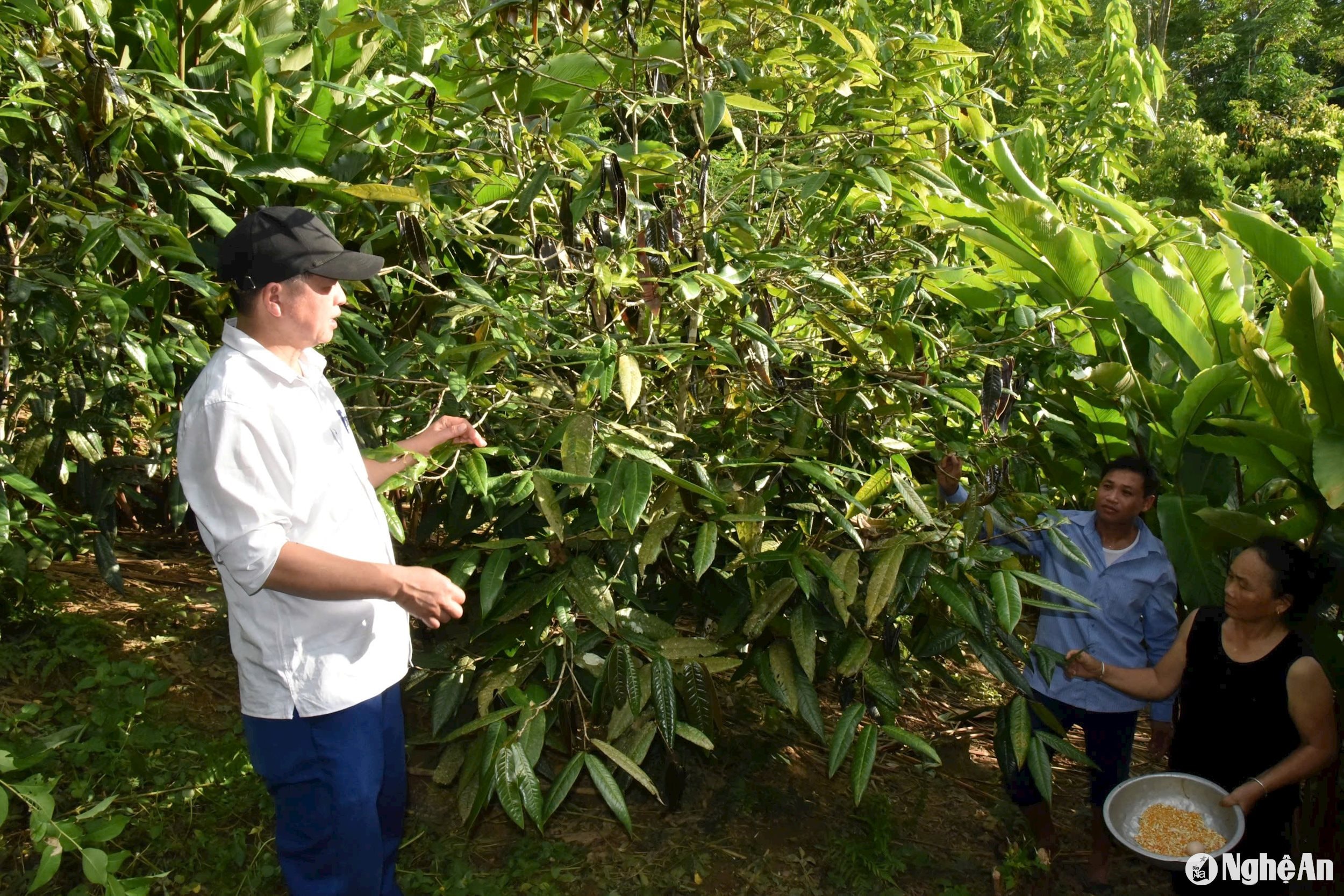
To preserve the genetic resources and expand the cultivation of golden flower tea, Mr. Sinh decided to leave one-third of the flowers to bear fruit for propagation and crossbreeding with other golden flower tea varieties from different localities; at the same time, he researched techniques for inducing flowering in tea plants under unfavorable weather conditions.
“If we let the fruit fall naturally and sprout into seedlings, it takes 6 months to get saplings, and because there is no selection, the plants grow less well. Last year, I started experimenting with propagation and succeeded with 500 seedlings planted in the forest garden, with an 80% survival rate. Hopefully, in a few years, I will successfully propagate the golden flower tea variety and have seedlings to supply to the market,” Mr. Sinh said.
.jpg)
He led us on a tour of the golden flower tea hill, covering an area of over 1 hectare, where thousands of golden flower tea plants were thriving beneath 15-year-old cinnamon trees. The newly sprouted tea buds were a deep purple, then they unfolded into larger leaves which turned purplish-red, then gradually changed to light green, dark green, and glossy green.
In just a few years, Mr. Sinh's tea plantation will yield a high income, estimated at hundreds of millions of VND per year, from harvesting the "Queen of Teas" flowers. "I started propagating the golden-flowered tea plants entirely on my own initiative, without capital, knowledge, or a partner. If possible, I would greatly appreciate support from cooperatives, associations, and relevant authorities in linking planting, production, and consumption…," Mr. Sinh stated.


