(Baonghean.vn) - With support and advice from agricultural extension programs, in recent years, many livestock and crop farming models in Thai Hoa town have developed sustainably and in greater depth. One of the principles that has contributed to the success of model owners in Thai Hoa is systematic investment, but during implementation, they must know how to "use short-term gains to support long-term growth" to both utilize local resources and gradually find markets for their products..
 |
| Mr. Nguyen Thai Nhan's New Zealand rabbit farming model in Dong Hoa hamlet, Nghia Hoa commune, Thai Hoa town, is the first large-scale rabbit farming model in Thai Hoa town. Starting with only 20 breeding rabbits he bought in 2016, after nearly two years, Mr. Nhan has expanded his herd to nearly 500 rabbits. Currently, a company in Hanoi guarantees the purchase of his rabbits. At a price of 70,000 VND/kg, each rabbit weighing 3-4 kg generates an income of 250,000-280,000 VND. Photo: Nguyen Hai |
 |
| Utilizing his nearly 2.5-hectare farm, Mr. Nhan also grows lemons and raises wild boars for breeding. In the photo: Mr. Nhan's wild boar farming model, implemented since the beginning of 2016, now has a herd of 13 sows, of which 4 have given birth to 6-8 piglets per litter. Currently, Mr. Nhan's family is investing in expanding the farm; if they receive farm certification and product origin certification, they plan to increase the rabbit herd to approximately 500 sows and the wild boar herd to about 50. Photo: Nguyen Hai |
 |
| The main food for rabbits is grass and leafy plants. However, to utilize family labor and readily available local materials, Mr. Nhan uses his land to raise earthworms; he also buys cassava pulp to ferment and process into daily feed for rabbits and pigs. With this method, Mr. Nhan saves costs and creates a very good source of organic feed for his rabbits and pigs. Photo: Nguyen Hai |
 |
| In 2013, Mr. Thai Quoc Huy, residing in Dong Hoa hamlet, Nghia Hoa commune (Thai Hoa town), boldly invested in converting 12 hectares of land previously used for growing acacia and eucalyptus trees to fruit tree cultivation. After nearly four years of investment, his family now owns a comprehensive farm with 5.5 hectares of oranges, 3 hectares of sugarcane, 1 hectare of Taiwanese guava, 1 hectare of apples, and many other fruit trees. Photo: Nguyen Hai |
 |
| Following the principle of "using short-term gains to support long-term growth," while waiting for the orange harvest, Mr. Huy also planted other short-term crops such as sugarcane, beans, pumpkins, and Taiwanese guava... With these short-term crops, he earns around 200 million VND annually to pay for labor and continue investing in the orange trees. (In the photo: a drip irrigation system using Isaren technology for 1 hectare of orange trees, supported by the Provincial Agricultural Extension Center in 2016. Currently, with the support of the agricultural extension project, Mr. Huy has invested over 150 million VND to install an irrigation system for the entire farm). Photo: Nguyen Hai |
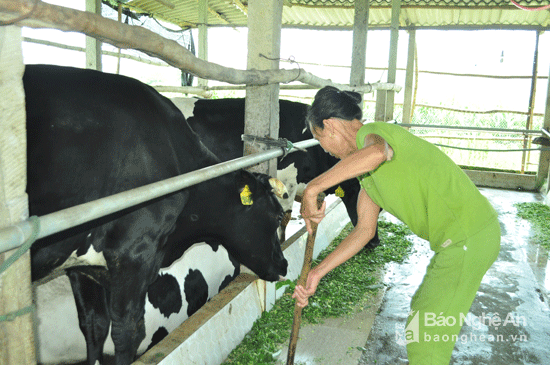 |
| With interest rate support from the town, in 2016, Mr. Tran Van Huu in Hamlet 5, Nghia Hoa Commune, boldly borrowed 250 million VND to buy 4 New Zealand dairy cows. To date, his family has a herd of 8 dairy cows, 4 of which are already producing milk. Each day, the herd produces 60 kg of milk (at the end of the season), priced at 14,000 VND/kg, resulting in an average monthly income of over 30 million VND for the family. Thanks to utilizing hillside land for grass cultivation and off-season agricultural labor, input costs have been significantly reduced. (Photo: Nguyen Hai) |
 |
| Starting with just one pomelo tree 10 years ago, the Quang Tien pink pomelo model of Ms. Nguyen Thi Loan in Trung Nghia Hamlet, Quang Tien Ward, now has 400 trees covering an area of 2 hectares. These 400 trees, already producing fruit, bring in an income of around 200 million VND per year for Ms. Loan's family and serve as a valuable source of seedlings for the town to further expand. In the photo: Ms. Loan is wrapping the pomelos to protect them from insects and fruit flies. Photo: Nguyen Hai. |
 |
| Agricultural extension officers from the town discussed with Ms. Loan the mechanisms for caring for the trees and building a brand to find a stable market for Quang Tien pink pomelos. Currently, according to the town's mechanism, in addition to receiving a subsidy of 50,000 VND per branch, households growing Quang Tien pink pomelos also receive 1,600 pieces of paper for wrapping the fruit when the trees bear fruit. Thanks to this incentive mechanism, dozens of households in Quang Tien ward alone have started growing pink pomelos, with three families in Trung Nghia block planting over 200 trees, equivalent to an area of 1 hectare or more. Photo: Nguyen Hai |
Nguyen Hai



