
A mechanism is needed to manage the Sao River reservoir.
(Baonghean) - The Sao River Reservoir is a large-scale irrigation project, providing water for thousands of hectares of agricultural land and supplying water to many other reservoirs and dams in Nghia Dan district and Thai Hoa town. However, during its operation, several factors have emerged that pose a risk to the sustainability of the Sao River Reservoir's water resources. Therefore, a coordinated management mechanism among relevant parties is needed...
HThe Sao River Reservoir began construction in 1999, was completed in 2003, and has been managed and operated for irrigation by Phu Quy Irrigation Company Limited since 2005. With a water storage capacity of over 51 million m3 across a 132 km2 catchment area, the reservoir is responsible for irrigating nearly 2,000 hectares of agricultural land in Nghia Dan district and Thai Hoa town, while also supplying water to other irrigation reservoirs in the area. In addition, water from the Sao River Reservoir plays a significant role in providing water for dairy farming at TH Group's farms.
To manage and protect the irrigation canal system, Phu Quy Irrigation Company Limited has established three management stations: the Head Station, the West Canal Station, and the East Canal Station. Mr. Dang Minh Duc, Head of the Planning and Technical Department of Phu Quy Irrigation Company Limited, stated: “Although we have to manage a long canal system that runs through many residential areas and hilly regions with complex terrain, the stations have operated and regulated water according to the agricultural schedule; the station staff and workers have actively stayed on the works and in the fields to promptly serve the water needs of the farmers.”
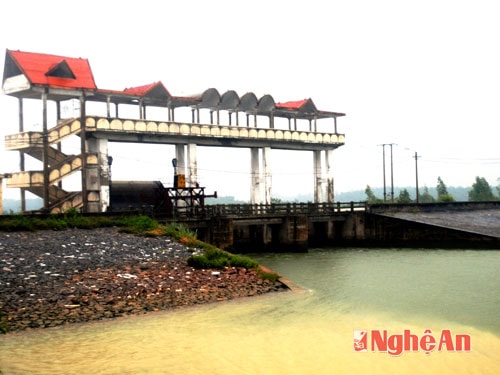 |
| Sao River Reservoir. |
Thus, it can be seen that the Sao River reservoir plays a very significant role in the agricultural development of the beneficiary localities. For example, the Dong Canal Management Station alone, along a canal length of approximately 20km including both main and branch canals, has provided irrigation for hundreds of hectares of rice and other crops in Nghia Binh, Nghia Hoi, Nghia Phu communes, Nghia Dan town (Nghia Dan district) and Nghia My commune (Thai Hoa town). At the same time, the Dong Canal Station also provides water for four reservoirs: Phu Tho, Binh Minh, Doi 7, and Lang Chang, along with many other small irrigation reservoirs managed by the communes. Therefore, coordination between localities, especially agricultural cooperatives, and the station is always a priority for all parties involved. Mr. Nguyen Thanh Duong, Chairman of Dai Dong Cooperative in Nghia Hoi commune, said: "Over the years, the coordination of water regulation between irrigation officials of the Dong Canal Station and the cooperative has been very smooth. Thanks to this, the Sao River reservoir has been able to provide water at the right time and in a timely manner for farmers' production."
However, the operation of the reservoir has revealed several negative impacts that need to be addressed. Mr. Dang Minh Duc stated: "According to reports from the operating stations, there are still instances of harmful actions affecting the quality of the canal system, leading to wasted water resources." Through discussions with officials and staff of the Eastern Canal Management Station, it was learned that some residents still throw various types of waste into the canal. There are times when station staff remove waste in the morning, only for it to be dumped back into the canal by the afternoon. In such cases, if not detected and dealt with promptly, it will lead to blockages or overflow of irrigation water from the canal.
Officials and staff at the Eastern Canal Management Station also reported instances of some residents digging or blocking water in the canal bed and diverting it into their gardens and ponds, or failing to close water valves after irrigation, allowing water to overflow from the canal and waste water resources. Mr. Phan Huu Dong, Head of the Eastern Canal Management Station, Phu Quy Irrigation Company Limited, suggested: “Previously, when irrigation fees were still payable, the awareness of those benefiting from irrigation water was better; but since the exemption, the encroachment on canals and the waste of resources in the station's management area have increased. Therefore, the most important thing is the involvement of local authorities at all levels to raise public awareness and encourage people to protect and preserve the canal system and use water resources rationally.”
Meanwhile, in the upstream area of the Sao River reservoir in Nghia Lam, Nghia Loi, and Nghia Lac communes, some people are still using inappropriate farming methods, affecting the sustainability of the water source. Mr. Le Trung Tam, Head of the Agriculture Department of Nghia Dan district, said: “Localities in the upstream area still have farming practices that cause siltation in the reservoir or encroach on the protective forest, affecting the Sao River reservoir's catchment area. In addition, the use of electric fishing devices still exists in the reservoir area.” Therefore, the People's Committee of Nghia Dan district has submitted a proposal to the Department of Agriculture and Rural Development of the province to allow the People's Committee of Nghia Dan district to establish a Steering Committee for the management and use of the Sao River reservoir water source in the district.
Mr. Le Hong Son, Vice Chairman of the Nghia Dan District People's Committee, stated: “Currently, the Sao River reservoir is operated by Phu Quy Irrigation Company Limited and provides irrigation for thousands of farmers in various communes and towns, but the reservoir's water surface is allocated to TH Group for fish farming development. Therefore, establishing a Steering Committee for the management and use of the Sao River reservoir's water resources will create a mechanism to bring together relevant parties to discuss and agree on a more coordinated and harmonious approach. This aims to achieve the goal of rationally and efficiently exploiting and utilizing water resources in the Sao River irrigation system, ensuring sustainability, protecting the surrounding environment, and mitigating existing negative aspects.”
In my opinion, establishing a coordinated management mechanism is the right approach to rationally and sustainably utilize the water resources of the Sao River reservoir. Especially in the context of Nghia Dan being designated as a high-tech agricultural center, ensuring sufficient water reserves is a crucial issue, in addition to land resources.
Thanh Duy


