
Due to the early-season drought, farmers in Nghe An had to pump out water to save their rice crops.
(Baonghean.vn) - These days, people in Hung Nguyen and Nghi Loc districts (Nghe An province) are very worried because the winter-spring rice fields are severely lacking water, with some fields already drying up and cracking despite it being only the beginning of the season.
Even though it was already midday, Mr. Ho Do Nhuan, head of Hamlet 5, Hung Phuc commune (Hung Nguyen district), was still out in the fields, urging villagers to bring out their diesel pumps to "save the rice crop." This work has been going on for the past week, but many fields are still completely dry.
 |
| The winter-spring rice fields in Hamlet 5, Hung Phuc Commune (Hung Nguyen District) have dried up and cracked despite being only at the beginning of the season. Photo: Quang An |
Mr. Nhuan shared: "Initially, we planned to use pumps to draw water from the river to save the rice crop, but then the river water gradually dried up, so we had to use diesel pumps to pump water from the fields that still had water to other fields that were dry. The cost of diesel for the pumps is no less than 100,000 VND per day. Although the efficiency is not high, this is the only way to save the rice crop at this time."
According to our observations, some fields in the communes of Hung Phuc, Hung Thinh, the town of Hung Thong (Hung Nguyen district)... have completely dried up even though the hot season has not yet begun. Some fields are luckier because they still have water, but the water level is only enough to cover the surface with a shallow layer, and after a few more days of sunshine, they risk drying up completely.
 |
| People are using diesel pumps to draw water from rice paddies that still have water, sharing it with those that are dry. Photo: Quang An |
It is known that the water levels in rivers and canals that supply and regulate water in Hung Nguyen district, such as the Cau Muou River, Hoang Can River, 12/9 Canal, Le Xuan Dao Canal, etc., have dropped very low. If there is no rain in the coming time, more than 5,500 hectares of winter-spring rice in the area are at risk of dying.
Mr. Hoang Duc An, Head of the Agriculture and Rural Development Department of Hung Nguyen district, said: "Never before has the early winter-spring crop experienced such a severe drought as this year. Most rivers and canals have low water levels. The pumping stations are all without water to operate."
"It's worth noting that this is the stage when rice plants begin to tiller, requiring a lot of water. However, with this situation, the rice plants will tiller poorly, affecting yield. In addition, rice blast disease is developing, and the drought is significantly reducing the effectiveness of disease control," Mr. An added.
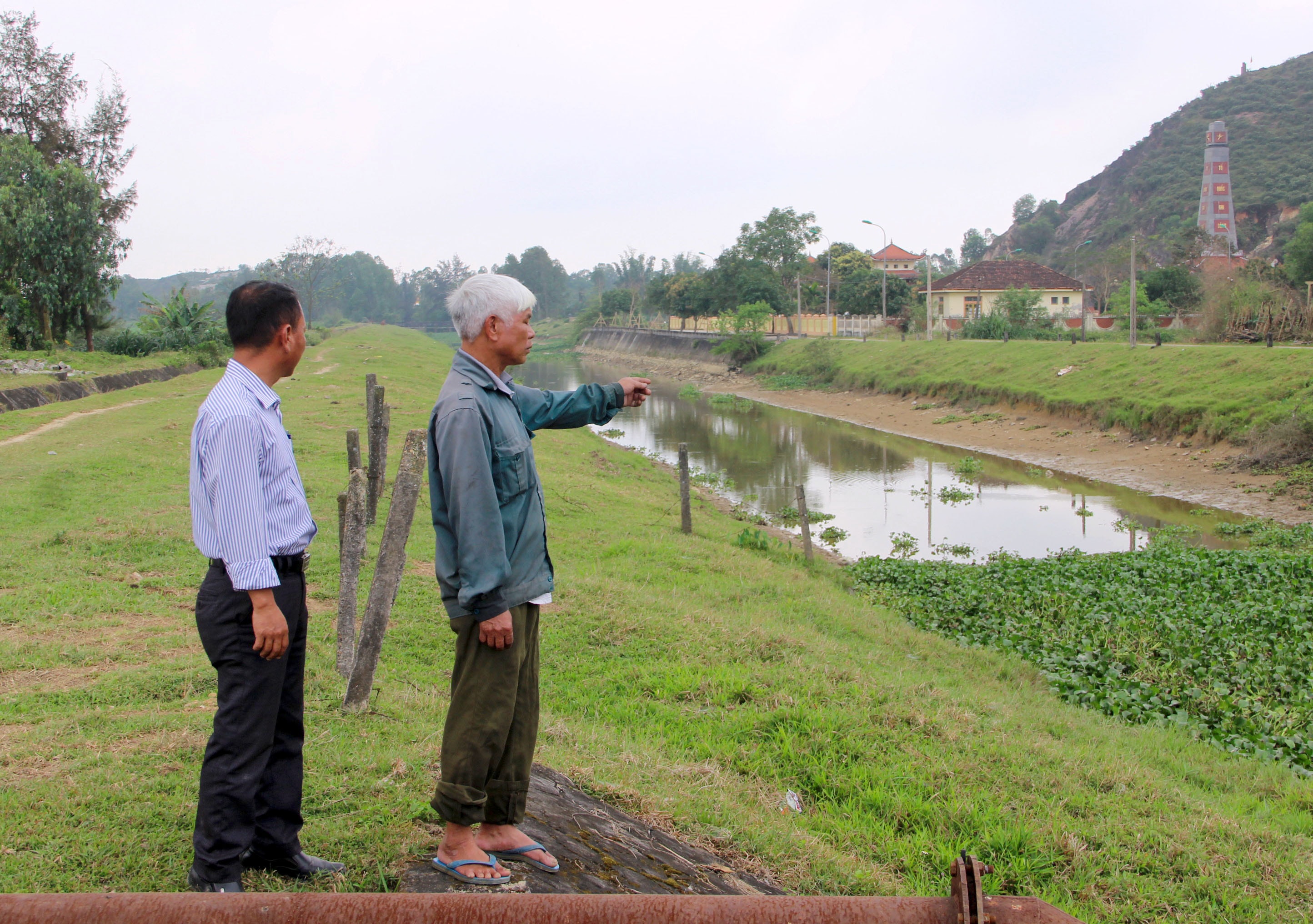 |
| Rivers and canals in Hung Nguyen district are gradually drying up and will become completely dry if there is no rain. Photo: Quang An |
Hung Nguyen District is directing localities to implement a rotational pumping schedule, prioritizing pumping for fields that are dry and cracked. They are making maximum use of tidal water from the Lam River, pumping whenever the water rises, regardless of the time. In addition, they are mobilizing people to focus on dredging canals and ditches to combat drought.
Nghi Loc district is also facing the risk of severe drought. Mr. Dong Thanh Binh, Deputy Head of the Agriculture and Rural Development Department of Nghi Loc district, said: This year, the entire district planted 7,800 hectares of winter-spring rice. The water level in the fields will only last for a short time longer. If there is no rain in the coming time, hundreds of hectares of rice will die or have difficulty flowering later. Many localities will experience severe drought, such as Nghi Yen, Nghi Long, Nghi Thuan, Nghi Van, Nghi Lam...
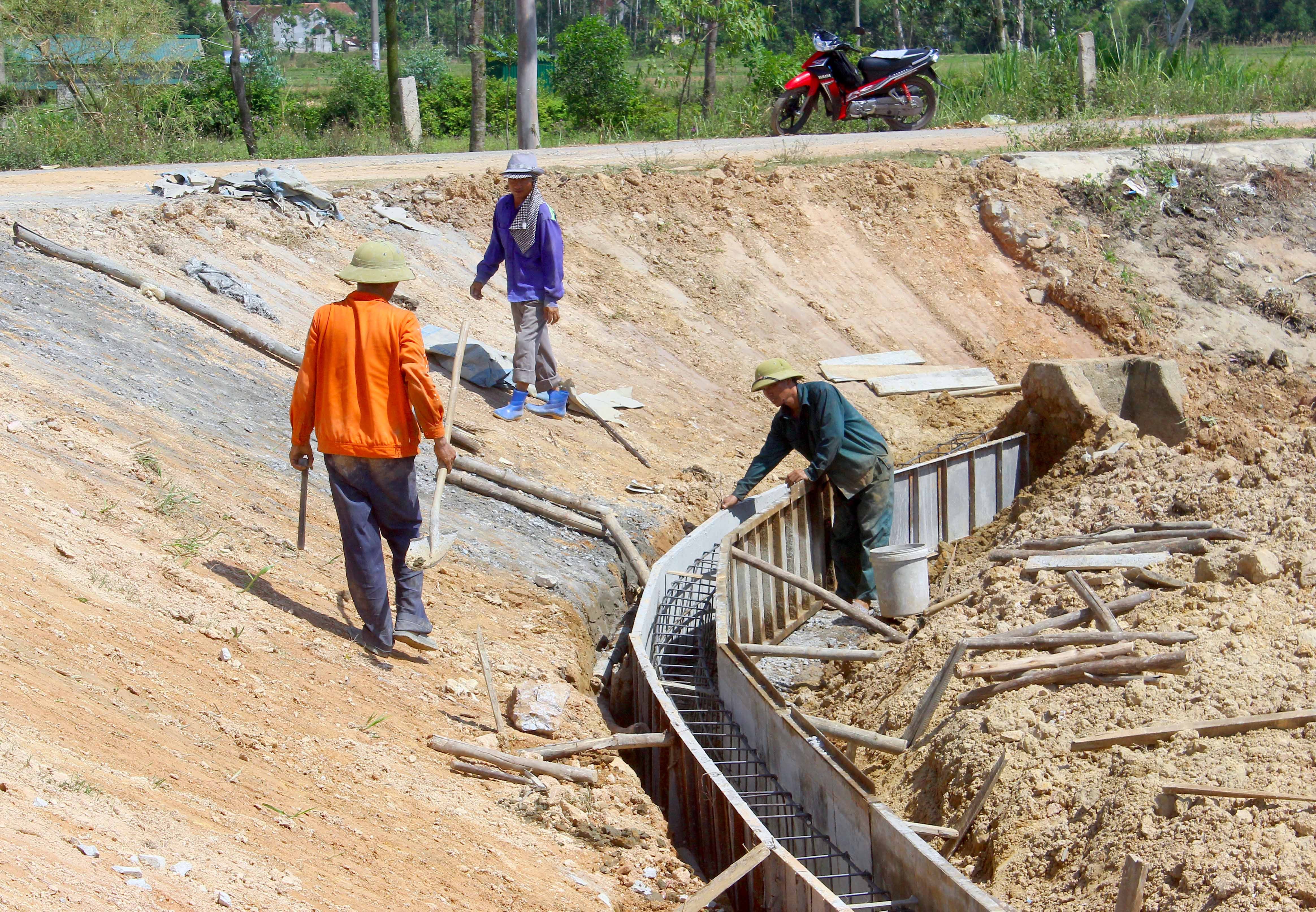 |
| Reinforcing embankments to prevent drought at reservoirs and dams in Nghi Van commune, Nghi Loc district. Photo: Quang An. |
Currently, Nghi Loc district is focusing its efforts on inspecting and repairing irrigation canals, dredging and reinforcing embankments to retain water, and directing communes to regulate water appropriately, avoiding indiscriminate pumping and adhering to assigned pumping schedules.


