
Improving the lives of ethnic minority people in Quy Hop
Over the years, ethnic policies have always been given attention and directed by the Party committees and government at all levels in Quy Hop district, ensuring timely and appropriate implementation for the target groups. This has contributed to socio-economic development and gradually improved the lives of ethnic minority people.
Multiply the joys
Quỳ Hợp Ethnic Boarding Junior High School was established in 2011. Due to difficult circumstances and a lack of funding for new construction, the school took over the second campus of the town's primary school. This campus, built in the 1990s, had severely deteriorated infrastructure, forcing students to study and live in temporary rooms, lacking proper accommodation and meals, and lacking basic facilities. This was the main reason why the school's academic performance at that time ranked only 5th or 6th in the entire district.
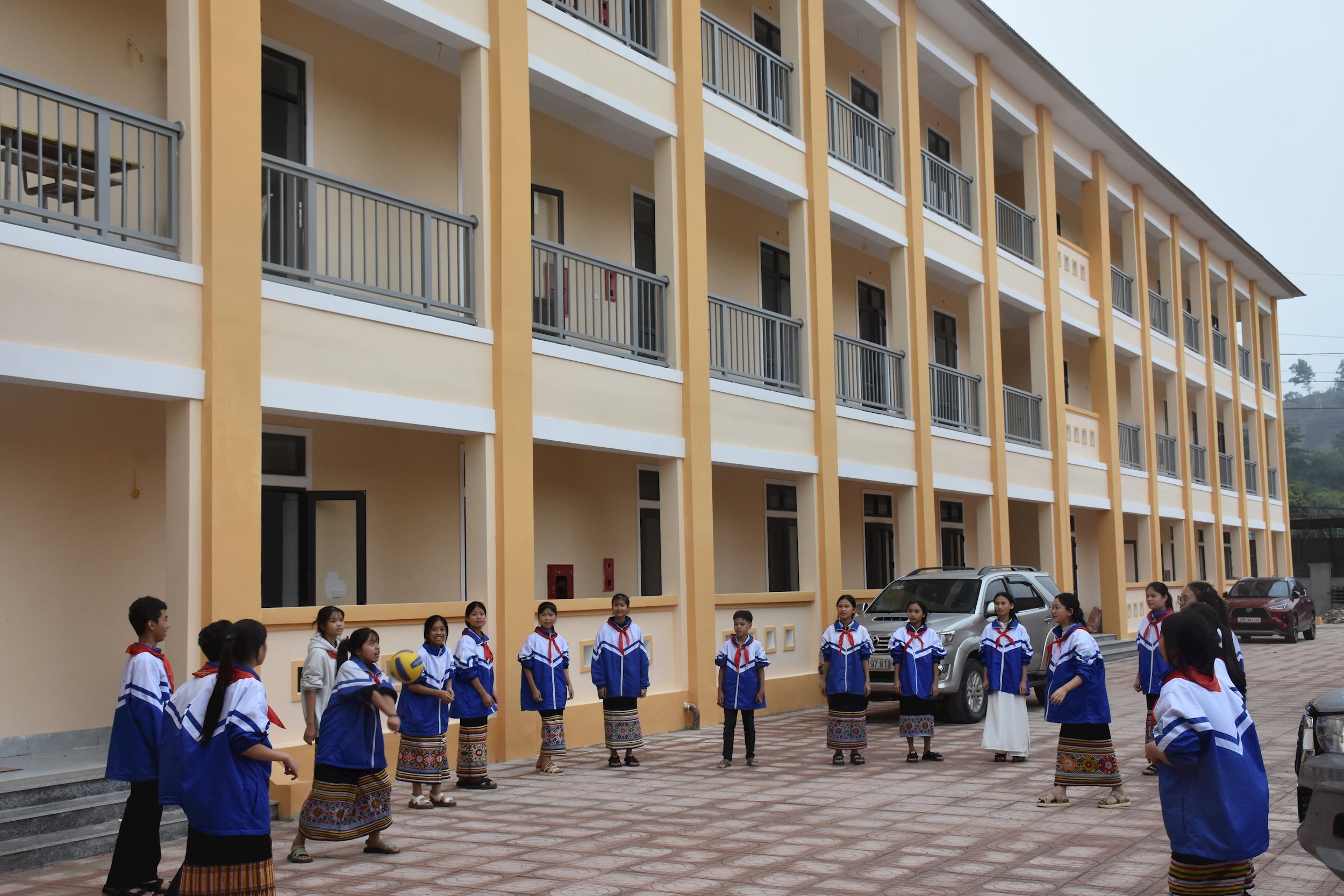
Mr. Dinh Van Tu, Principal of Quy Hop Ethnic Boarding Junior High School, said: "From 2016 to the present, the school has received attention and investment from higher authorities, resulting in modern facilities, which has greatly pleased the teachers and students. The implementation of specialized ethnic education is ensured. Currently, the school has a two-story school building with 12 classrooms; a boarding house with 13 rooms; a dining hall; and a multi-functional school building with 6 functional rooms. Teaching equipment, living supplies, and student care supplies are provided fully and promptly."
“In 2024, the school continued to receive state support for repairs and upgrades, transforming the two-story school building into a three-story building with 18 classrooms; a three-story student dormitory with 39 rooms; a student cafeteria; and the construction of a new dormitory caretaker's house, rice storage facility, and canteen... with a total budget of over 23.5 billion VND. Thanks to this investment in facilities, meeting the teaching and learning conditions for teachers and students, in recent years, the school's overall academic performance has ranked first in the entire district; and its outstanding students have ranked second and third in the entire district,” teacher Dinh Van Tu further shared.
Studying in a well-equipped environment, Lo Thi Khanh Bang, a Thai ethnic student in class 9A at Quy Hop Ethnic Boarding Junior High School, said: "The classroom has a TV with internet access, so we can easily apply information technology and access many useful resources. As a result, our academic performance is improving."
Ha Son is a particularly disadvantaged mountainous commune located 21 km from the center of Quy Hop district, traversed by National Highway 48D. The commune has 1,101 households with 4,637 inhabitants, distributed across 7 hamlets, with ethnic minorities accounting for over 90%. To meet the healthcare needs of ethnic minorities, at the end of 2022, the commune's health station received investment for construction under the National Target Program for socio-economic development in ethnic minority and mountainous areas. After nearly a year of intensive work, the project has been completed and put into operation.
Ms. Truong Thi Hien, Head of the Ha Son Commune Health Station (Quy Hop District), said: “Previously, the commune health station was severely dilapidated, with insufficient working rooms, and even the doctor's room had to be used as an emergency room for patients. At times, due to changing seasons, dozens of children fell ill, and the station staff had to spread mats and set up beds along the corridor, giving up the on-call room for patients to lie down.”
"Thanks to the attention and investment from the Party and the State, a new health station has been built with a total cost of 4.9 billion VND. Designed as a two-story building with 16 spacious offices and a clean, beautiful परिसर, it meets the needs of patients for examination and treatment. In the future, we will continue to improve the professional skills of our medical staff, contributing to ensuring the necessary conditions for building a commune health station that meets national standards."
Creating motivation for development
Implement the central and provincial documents on the implementation of the National Target Program for socio-economic development.ethnic minority areasFor the 2021-2025 period, the implementation of the program in Quy Hop district has received attention and guidance from the entire political system, from the district to the commune level. The District People's Committee issued a plan to review the capital needs for program implementation and established a Steering Committee for national target programs in the 2021-2025 period in the district.
According to the results of the National Target Program for socio-economic development in ethnic minority and mountainous areas for the period 2021-2025, Quy Hop district was allocated investment for the construction of 130 projects, with a total capital of over 339.6 billion VND.
To date, a total of 250.7 billion VND has been allocated. With the disbursed funds, Quy Hop district has promptly supported 51 out of 52 households in building houses, with over 2 billion VND disbursed, reaching a rate of 72.22%; and invested in the construction of 85 projects, with a total allocated capital of 247.8 billion VND, of which 178.5 billion VND has been disbursed, reaching a rate of 72.05%. Specifically in 2024, the entire district has commenced construction on 19 out of 23 new projects with a total investment of 56.7 billion VND; of which, 21.6 billion VND was allocated and 11.3 billion VND was disbursed (disbursement rate of 52.41%).
Regarding operational funding, to date, 167.4 billion VND has been allocated to 9 out of 10 projects under the National Target Program for socio-economic development in ethnic minority and mountainous areas for the period 2021-2025 (allocated annually from 2022-2024). Of this amount, 51.2 billion VND was allocated in 2024. Over 24 billion VND has been disbursed for these projects, representing a disbursement rate of 22.91%. Programs, projects, and investment policies supporting ethnic minority areas in the district have always been implemented synchronously, promptly, and in accordance with the objectives, target groups, and regulations of the State.
With the support of the State and the efforts and striving of the people, the socio-economic situation in the ethnic minority and mountainous areas of Quy Hop district has improved significantly. Infrastructure has been improved in a synchronized manner; the economic structure continues to shift strongly towards commodity production; the material and spiritual lives of ethnic minorities are constantly improving; traditional culture is preserved and promoted; political security, order, and social safety are ensured; and the grassroots political system is strengthened and consolidated...
By the end of 2024, all targets were met or exceeded; 100% of communes had paved roads connecting the district center to the commune center; 100% of communes and towns had health stations; 98.7% of households had access to safe electricity; 100% of schools (with boarding students) in particularly difficult and border areas had housing, kitchens, and sanitary facilities that basically met the needs of students at all levels; 87% of the rural population had access to clean drinking water; 100% of ethnic minorities in difficult areas, poor households, and near-poor households were granted health insurance cards; the percentage of households using clean and hygienic water reached 87%. The entire district had 6 communes that met the standards for new rural areas and 1 commune that was building an advanced new rural area...
In the coming period, the district will continue to accelerate the progress and finalize the accounts for projects completed in 2024; simultaneously, it will implement the plan for the National Target Program on socio-economic development of ethnic minority and mountainous areas in Quy Hop district for the period 2022-2025 in a timely manner; continue to propose and maximize investment capital support from the Central Government and the province for investment programs and projects in ethnic minority and mountainous areas within the district; coordinate inspections, audits, and supervision of some programs, policies, and projects that have been and are being implemented in some facilities in the district; and strengthen coordination in organizing inspections of the implementation of policies and regulations for ethnic minorities and mountainous areas.
Mr. Hoang Van Thai - Vice Chairman of the People's Committee of Quy Hop District


